Showing posts with label Western Front. Show all posts

Wednesday, May 25, 2016

Building a Mid-War French Force for Through the Mud and the Blood

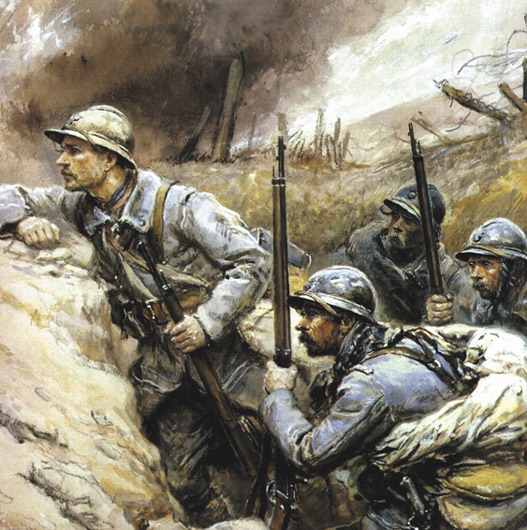
French infantry in the trenches. (http://www.151ril.com)
Les Poilus!

One of my chum's sons, already an avid wargamer, has expressed an interest in playing a Great War miniatures game, with a particular interest in the French. Or some other options (he likes the underdogs), but since I'm learning and blogging about the great Verdun campaign just now, I seized on his interest as an opportunity to build a French force for Through the Mud and the Blood.

He's OK with either early war or something later. But , although they would look glorious in les pantalon rouges, the early war French would be at best a platoon of 58 corporals and riflemen with a three sergeants and a solitary lieutenant as platoon commander. Not much chance of one of the regiment's two machine-guns, even.

But by 1916, though drabber in the horizon bleu, the platoon becomes much more interesting. A greater range of infantry armaments and more complex tactics to use them effectively created a more diverse platoon organization. Still commanded by l lieutenant and three sergeants, the platoon now consisted of 40 men, including 4 dedicated rifle-grenadiers (with two ammo carriers), 2 automatic-riflemen (with 2 ammo carriers and 2 assistant gunners), and a squad of 8 grenadiers (including throwers, ammo carriers, and assistants).

I also (since this was my delayed tax-refund splurge, and I was buying from Old Glory 25s and thus using my discount from their Army Member programme), got some support elements. The platoon will be able to call on some Hotchkiss HMG support, a 37mm infantry gun, and some trench mortars, if needed. There are some special figures to represent any trench-fighting party they may send out at night to recce the enemy lines to to grab a prisoner or two. And they will have some extraneous chappies hanging about: some spotters for the divisional artillery,

I'll be going through all my old Lardy Specials as well as delving into the M&B forum to see if any ideas crop up that might be useful. But undoubtedly of most value will be all the posts on the excellent Roundwood's World blog about his Verdun Project. I'm also finding the website of the 151e Régiment d'Infanterie de Ligne (a living history group) invaluable.

As a starter, I'd like to portray an attack and a counterattack from the fighting over the Bois des Corbeaux (like my mum, I love the corbies) on the left bank of the Meuse, part of the beginning of the second stage of the Verdun campaign in March 1916. But first I need to do some painting!

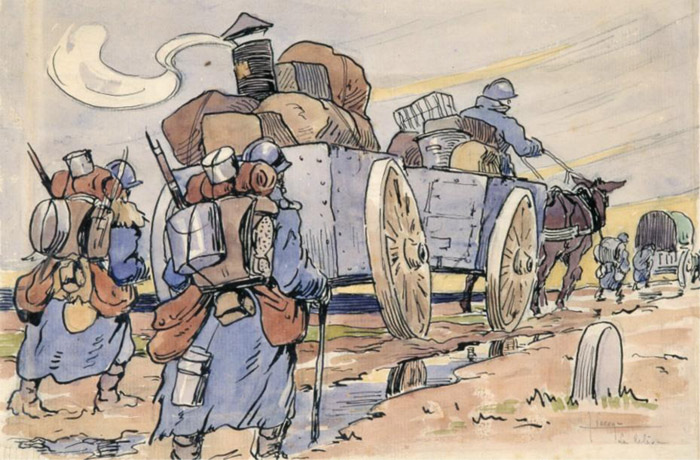
French field kitchen and baggage. (http://151ril.com)

Friday, January 15, 2016

Closing the Books on 1915: New Games, Part Four

Quick! I've got to finish off reporting on 2015 before 2016 gets any older! Last but not least in my tally of Great War games from last year, the operational scale games.

Let's start off with the games I can say the least about, because there's not much information or opinion on them out there yet. First in that category should be White Dog Games' The Russian Empire Strikes Back: Lodz 1914, since I can tell you only the barest details about it. It features an 11"x 17" map, 88 counters, and an eight-page rulebook, which includes provisions for solitaire play. Michael Kennedy designed the game, which appears to be very fast playing, featuring a swirling winter battle on the Great War's Eastern Front. It has one rating (a 9) on BGG.

Next up would be Fateful Days: Marne Campaign of 1914 is one of ATO/TPS's Pocket Battle Games, games whose map, counters, and rules are all printed in on a card the size of an old-fashioned postcard, making them the perfect promotional piece and an easy way for a designer to get an idea out in the marketplace. It's designed by the incredibly prolific Paul Rohrbaugh. I have a stack of the Pocket Battle Games, but I don't have this one, so I can't give a report on the rules of how it plays. Four people have rated it in BGG: two 7s, a 6, and a 5.

Third in this category is Decision Games' Lettow-Voerbeck: East Africa 1914-1918. This is one of Joseph Miranda's Mini Series games for Decision, 11"x17" maps with 40 counters and fairly simple rules. Seven BGG users have given this depiction of the fighting in East Africa a mean 6.69 rating. It's an area-movement game, with a card-driven dynamic (what DG refers to as the "Hand of Destiny" system). I have a number of DG's Great War games, but none from this Mini Series or that use their card dynamic.

1914: Germany at War comes from the teeming brain of Emanuele Santandrea, designer at Milan's VentoNuovo Games. It's his first Great War game; the second, 1914: Austria Hungary at War  is expected to hit the shelves in 2016. Santandrea and VentNuovo also published the highly popular bicentenary Waterloo 200 last year, but his bread and butter has been a series if World War Two games. VNG appears to be Italy's answer to Columbia Games, having published a slew of block games, starting with World War Two and now moving to the Great War; they have an inter-war period game, Time of Decisions, slated for 2017. Germany at War gets a 9.06 mean rating from 15 BGG scores. Judging from photos, it's a big, colourful game. I just skimmed some of the playtesting reports, but the fog of war resulting from the use of blocks combines with diceless combat based on strength differential (and some other considerations) to make this--I would guess, a rules-light but strategy-heavy game. I very much look forward to finding a chance to play either this or its Austro-Hungarian cousin. It's worth noting that Germany at War covers just the first four months of the campaign.

The latest entrant in Michael Resch's 1914 series is 1914: Serbien Muss Sterbien (SMS). In the latest installment (preceeded by 1914: Twilight in the East (TiE) and 1914: Offensive a Outrance (OaO)), Resch portrays the opening portion of Austria's invasion of Serbia in 1914. Resch's games are not simple: they provide a highly detailed look at operational warfare waged by the Great War's huge armies, and they demonstrate the extensive research and modeling that Resch undertakes. SMS deals with some fairly arcane and complicated terrain and armies, as reflected by the game's terrain rules and by the sections of special rules for Serbian, Montenegrin, and Austro-Hungarian forces. But the size and scope of the campaign still makes SMS (one 22" x 34" mapsheet and ~500 counters) more approachable than TiE or OaO(each with three or four map sheets and over 2,000 counters). In addition, this title casts some light on geography and combatants not familiar to most wargamers, even many devotees of the war that was spawned by the tensions between the Dual Monarchy and its Serbian neighbour. This game has garnered a mean BGG rating of 7.76 from 20 users.

The last title listed as published in 2015 is GMT Games' Gallipoli 1915: Churchill's Greatest Gamble. This is rather an outstanding fudge, as Gallipoli has not yet been published. However, the publishers have supplied a good deal of information about it (here's a link to the articles on Inside GMT that are tagged for Gallipoli), and it looks like it's going to be a doozy. This will be a huge (three-map, 1,000-counter) game, covering the initial landings on the Gallipoli peninsula and the first three days of fighting. As such, the stalemate of May, June, and July, and the follow-up landings in August at Sulva Bay are left to a later game/expansion. But avid Gallipoliphiles will still have their work cut out for them here. The replays and introductions to the rules provided on GMT's blog have been clear and easy to follow, but they involve quite a lot of detail. The rules appear easy to learn, but there's a lot of tactical detail to appreciate and learn how to effectively manipulate. I expect that players will want to play and replay this as their grasp of the rules develops into a grasp of the way to fight their units in the campaign. Nonetheless, the whole package looks terrifically appealing; I've pre-ordered it myself and can't wait to see it finally come out.

Gallipoli is, oddly, a campaign beloved by history buffs (wargamers included) and one that seems to cry out for the "what if" opportunities that games provide, but one that has been poorly covered. Paper Wars Games published a game on the topic (high level, low counter density) in 1979 called simply Gallipoli that has lived a somewhat obscure life (fewer than 50 BGGers own a copy and only 14 have rated it). And ATO's A Fatal Attraction has been a classic ATO title: a fascinating subject given a highly original graphic presentation and an innovative design (Paul Rohrbaugh again) but crippled by poor writing and development. Even one of its strongest proponents on BGG (David Hughes), who loves the game and has played it against its developer, states in his review that "game just cannot be played using the rules as written". The central part of the command and control rules that determine how and when players can activate units "are impenetrable, contradictory, over-concise, and have confused everyone I know who has played," according to Hughes. The victory conditions are also, apparently, a problem, as the Allied player can manage a win by refusing to land troops, bombarding some Ottoman forts, and, essentially, declaring victory and sailing home. Undoubtedly a better outcome for all involved than thew historical campaign,but hardly a depiction of what happened. One hopes that someday ATO will clean up the rules and make the game more playable.

Thursday, May 14, 2015

The Western Front in Spring, 1915

While I've been writing recently about the 1917 battle for Vimy Ridge (which I'll be looking at some more soon), I'd like to step backwards for a moment and look at the centennial time line.


The Spring of 1915 had seen action on most of the fronts in the war. From January onward, fighting was taking place in in France and Belgium, in East Prussia, Galicia, in Turkey (the Dardanelles, the Aegean islands, and the Caucasus), Mesopotamia, Persia, the Sinai, Arabia, West, South, and East Africa, even in Afghanistan and India (that portion that is today Pakistan).


Naval combat had taken place in the Atlantic, including the North Sea and the Channel, the Mediterranean, even in the Pacific, where a German ship was sunk off the coast of Chile. Although not a combatant, the United States had seen its first ship attacked by German submarines (the SS Gulflight in May); Sweden had the dubious distinction of being the first neutral country to lose a ship to U-boats (the SS Hanna, sunk without warning in March). American had even "captured" its first German vessels: the armed merchant raiders Prinz Eitel Friedrich and Kronprinz Wilhelm were interned in Newport News, Virginia, in March and April 1915.


Some of the war's new horror weapons had seen their first use in the Spring of 1915. Germans fighting in the Western Front's trenches in February had used flamethrowers for the first time. The first use of poison gas by the German and French armies took place in April. German airships made their first bombing raid on England in January.


And under a manmade hill in Flanders, hundred of British and Australian soldiers dug like moles, building a system of tunnels that would be packed with more than three tons of explosives. These explosives would be detonated in the first of innumerable mine attacks that took place across the Western Front of the rest of the war. Battles were not now restricted to the trenches or the skies above, but also took place in muddy tunnels far below the surface, as one group of diggers tried to outdo, foil, or eliminate their opponents.


This mine attack on the promontory known as Hill 60, near the Belgian city of Ypres, was a relatively small British action sandwiched in among a series of much larger offensives. In December of 1914, the French had begun an offensive in Champagne, seeking to take advantage of a rumoured move of German reserves to the Eastern Front. Two French armies attacked, made limited progress, and stalled as they fought off German counterattacks. Supporting attacks in Artois and in the Vosges Mountains had even less success, either at moving forward or at forcing Germany to halt redeployment of troops from the West to the East. The First Battle of Champagne ended in mid-March.


At about that time, the British made a highly successful but limited attack, trying to capture some high ground and cut German supply and communications lines. Although the two British and two Indian divisions involved burst through the German frontlines after a powerful bombardment, they were unable to communicate effectively with their supporting forces after battle had joined, and so the army was unable to exploit their success fully. German counterattacks again halted the Allied advance but left them in control of the town of Neuve Chappelle. The huge drain on ammunition supplies that the bombardment caused was Britain's first hint of the wholly unanticipated demand that modern warfare would make on  domestic industry's ability to produce artillery shells.


The Champagne offensive, the battle of Neuve Chapelle (March), and the attacks on Hill 60 (April) represented the Spring Allied initiatives on the Western Front. They were followed by a German offensive, which began the Second Battle of Ypres (April and May). This attack was the Germans' first to employ poison gas on the Western Front. At Gravenstafel, northeast of Ypres (and Hill 60), the Germans conducted a major gas attack on troops of two French divisions. The French forces, a Territorial division and a division of tough Algerian troops, broke in horror at the effect of the strange toxic cloud boiling over their lines. Apparently the Germans underestimated the effect the gas would have, as they had planned only a limited advance to exploit the hole made in French lines by this unexpected weapon.


Troops of the Canadian Expeditionary Force moved to hold the east side of the German breakthrough, and despite a second gas attack the following day, the German advance was brought to a halt, having driven in the northern flank of the Ypres Salient by as much as two miles. The Germans renewed their offensive in early May and again later in the month, using more poison gas, along with a heavy artillery bombardment, and further reduced the salient.


At the same time, the French and British were engaging in their last offensive for the Spring and Summer of 1915, an attempt to reduce a German salient in Artois that projected westward from Lens to just north of Arras and included our old friend, Vimy Ridge. The French planned a massive attack with six infantry corps, a cavalry corps, an infantry reserve of three divisions, and an artillery supporting force of nearly 300 heavy guns and over  1,000 field guns. The supporting British attacks featured three corps. German forces defending the region number slightly more than half the Allied strength, but they were heavily dug in, held the area in depth, and was well positioned on high ground in most areas.


The battle began in early May and lasted through late June. Fighting followed a familiar pattern: early French gains, following careful planning, new tactical training, and massive artillery bombardments, proved hard to keep building on. Communications and movement of reserves were slow and clumsy over heavily shelled ground, dogged German counterattacks and counterbombardments disrupted efforts to consolidate on captured positions and to push forward. Although many German reserves had been dispatched eastwards to shore up the front after disastrous Austrian losses, the Westheer still had more than enough troops and guns to blunt and in places reverse the French thrusts, especially since they were operating over less disrupted terrain.


Both sides learned different lessons. The French, always attached to the offensive, were heartened by their initial success--if the right preparations could be made, officers like Joffre and de Castelnau insisted, sudden breakthroughs could still be achieved. Others, like Foch and Petain, still believed in the offensive, but felt that operations in Artois had shown that more limited attacks, with limited objectives, gained ground more slowly but led to gains that could be held, rather that bold leaps forward that were just as quickly driven back.


The Germans, on the other hand, perceived that the Allies' preparatory bombardments caused significant disruption; they began looking for ways to make their defenses more resistant, both by digging them deeper and stronger and situating their main defensive belts in positions where they were not directly overlooked by Allied positions, so that they survived offensive preparations in better condition, making penetration and capture by attacking forces more difficult and more costly in causalities.