Showing posts with label 1916. Show all posts

Thursday, April 7, 2016

Verdun Wargames: An Overview

French fortifications at Verdun (The Illustrated First World War)
There are, that I can identify, six board wargames that focus on the battle of Verdun. I've been able to get my hands on four of the six, and I will try to provide an overview of them here. Later during the course of the year I hope to provide replays of all or most of them.

Most of the Verdun games cover only the opening month or so of the battle, perhaps assuming that if the Germans have not completely overrun the French defenses by then, the battle will lose interest as a game. While that may be an accurate assessment at the entertainment level, it seems to me that it completely ignores the historical context of the battle. Von Falkenhayn did not necessarily expect to capture the city of Verdun outright. He planned to hit the defenses of the fortified zone hard, putting German troops in positions that the French would have to try to recover. But, he assumed, German artillery was so much more powerful than that of their enemies, German skill at creating defensive positions so much greater, that when the French counterattack came, German forces would be in a position to destroy the counterattacking troops. The French would be forced to pull in more troops from other fronts, and the campaign would destroy France's strategic reserves of manpower, already considerably lower than Germany's at the beginning of the war and further depleted by the Allied offensives of 1915, in which France and Britain had suffered far more casualties than they had inflicted.

Historically the Germans did inflict something close to crippling losses on the French in the fighting around Verdun in 1916; France lost in the vicinity of 500,000 killed and wounded (and maybe another 100,000 in  Nivelle's offensive the following year). But Germany had suffered crippling losses as well, because holding the positions that they took required the sacrifice of almost an equal number of troops to those that the French lost in attacking them. So I think one needs to look at more than a week or two of the offensive to determine whether the player can do better than their historical counterparts did.

Singular among the Verdun half-dozen is the most recent title, Roger Nord's Verdun: A Generation Lost. Singular because of all the titles I've seen so far, it attempts to cover the entire Verdun campaign, from its beginning in February to its conclusion in December.  The game includes separate scenarios breaking down the campaign into manageable pieces, but the option is there to play the whole eleven-month ordeal.

Also unusually, V:GL uses squares (each about 1000m across in scale) rather than hexes to regulate movement and fire. Its map covers a wide area around the city and its defensive ring, and it includes both the west and east banks of the Meuse. It gets the second-highest rating of the six, a 6.92 from 19 BGG users. Its rules cover 20 pages covering weather, bombardment, movement, assault, and reorganization of disrupted units, and an additional 12 pages of scenario information and tables. Resources available to one or both players include lifting or creeping barrages, smoke screens, engineers, flamethrowers, gas attacks, night attacks, counterbattery fire, French quick-firing 75mm howitzers, defensive fire, forts, mines, and air attacks. German units are depicted as regiments and battalions; French units are divisions and brigades.

Nord used the same system in his 2005 game The Big Push: The Battle of the Somme, which depicts 1916's other great and sanguinary combat. I'm looking forward to mastering this system, as I'm hoping to use both these games to gather some insights into 1916's two biggest Western Front campaigns.

Verdun: The Game of Attrition was published in 1972 by Conflict Games and designed by the late, great John Hill (father of Squad Leader and Johnny Reb). Its map covers only the fortress ring, and only the east bank of the Meuse. Units are rated for combat and movement and are exclusively infantry and artillery battalions. BGG users rated it 6.71 across 46 responses, making it the third most popular of this sextet (in addition to being the oldest).

One of the things that's remarkable about V:GA is the brevity of the rules. It comes with a generic introduction to board wargames that consists of one page of rules and a one-page FAQ. The rules for the game itself consist of a cover page and three pages of text and diagrams. Four or five pages of rules--most simple Euro games these days come with twice that much.

Despite that brevity and the simple counterset, the game includes period details like multiple varieties of artillery bombardment, counterbattery fire, phosgene gas, flamethrowers, tunnels, weather, demoralization, French fanaticism, and eight types of terrain. I'm going to try this game out first, probably, just because it has such an amazing combination of simplicity and detail.

V:GA was later (2004) republished with a graphics upgrade by Cool Stuff Unlimited. I don't have a copy of this edition, but I see nothing to suggest that the rules were edited or altered from the original edition.

The most popular of the Verdun games is Verdun, a Dagger at the Heart of France, published in 1978, also by Conflict Games (and apparently reprinted at some point by GDW, to judge by some photos of the mapsheet) and designed by the famous Marc Miller (creator of the Traveler RPG as well as designer of many of GDW's historical offerings).

Billed in its BGG description as a "based on" V:GA, this title is also described as "a completely new game". It wins a 7.02 from 25 ratings. The BGG description refers to its mechanics as "conventional", but the game includes artillery ammunition rules as well as spotting, pioneers, poison gas, fortifications, and general supply rules. The map covers a broader area than just the fortress ring, and it includes both banks of the Meuse. Until I can find an affordable copy, that's about as far as my review can go.

In the middle of the pack, in terms of popularity, is Avalanche Press' They Shall Not Pass: The Battle of Verdun 1916, rated on average 6.61 by 82 BGG users. The stunningly ugly map covers the fortress ring on the east bank of the Meuse only at 700 meters per hex. Its rulebook is half-sized (5.5" x 8.5"), yielding about 11 conventionally sized pages that cover the basics like bombardment, movement, assault, morale, and breakthroughs as well as special rules for hasty defenses, fortifications, German pioneers, and French chasseurs a pied. Infantry units are regiments and battalions; artillery units are batteries.

Tied for least popular of the Verdun games is Joseph Miranda's Over the Top! Verdun published in S&T by Decision Games. It gets a 5.86 from 36 ratings. It is part of a series of Great War games that Decision has published, covering eight battles in all from different periods of the war and different theatres.

The other least popular version of the battle is Verdun 1916, published in Vae Victis magazine. I can say the least about this game since I have yet to get hold of a copy of it. Its turns are a day each; its map scale is 850 meters to the hex; combat units are regiments and battalions. Infantry and stormtroop units have combat and movement factors; artillery have bombardment, defense, and movement factors; air units have bombardment factors; and command units have command range, defense, and movement factors. The map, like V:GA and TSNP, shows just the area in the immediate vicinity of the fortress ring, though it does include both the west and east banks of the Meuse. Since it was published in 2002 it has garnered 38 ratings to get it's 5.86 rating BGG.

Several of the macro games that cover the entire war in Europe or the war on the Western Front have scenarios that are billed as Verdun scenarios, but by and large they cover the entire front. While that does allow the player to explore the larger context of the Verdun campaign, they're not in quite the same category as these games, which focus on the Verdun fighting alone.

Coming up: Vimy Ridge Day (April 9). Also, other theatres, other battles--1916 campaigns outside France and Belgium.

Wednesday, January 27, 2016

Looking Back at 1915, Looking Forward to 1916.

1915 (a brief timeline)
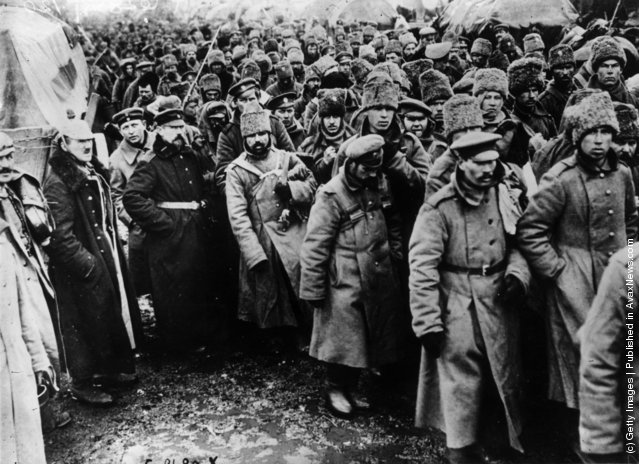
Russian POWs in the Masurian Lakes Campaign (Great War Project)


I never finished my overview of events in 1915. Baldly put, the Western Front, despite the first mass use of poison gas, was a gruesome stalemate, but not the hecatomb it would become in 1916. Several campaigns were begun, sputtered, and went out; the Second Battle of Ypres was perhaps the most notable.

The Eastern Front saw more movement, with fighting in the Masurian Lakes of Prussia, and in Galicia and Poland proper. First the Russians suffered disaster, then the Austrians, then the Russians again, and the year ended with the Tsar taking over command of the war from the generals.

In the Mediterranean, 1915 saw the bloody and eventually pointless Allied invasion of the Gallipoli peninsula of Turkey. Italy, lured by promises of increased territory, betrayed its pre-war allies and declared war on Austria-Hungary, sparking the repeated and useless battles of the Isonzo. Allied forces also landed in Macedonia in October, opening up a mini-front that almost immediately fell into senescence as they failed to advance far from their base at Salonika.The British campaign in Mesopotamia, that had begun in late 1914, crawled slowly forward, with the British winning several victories that gave them cause to hope the region could be subdued in the next year.

Artist's representation of a zeppelin raid (Ian Castle's Zeppelins, Gothas and Giants)
The war expanded into new dimensions, as Germany's zeppelins began bombing raids on the United Kingdom. And Germany declared a blockade of the UK as well, seeking to enforce it with attacks by its fleet of u-boats.

Parts of my Great War-game collection that bear on events in 1915:

Western Front (Artois)
In Flanders Fields (Second Ypres)
Loos: The Big Push
Masuria: Winter Battle 1915
Galicia: the Forgotten Cauldron
Gorlice-Tarnow Breakthrough
Jassin 1915 (the East Africa Campaign)
Serbia the Defiant (a second year of fighting sees the Serbian Army driven from their country, if not defeated)
The Italian Front (First Isonzo)
A Fatal Attraction: The Gallipoli Campaign
Osmanli Harbi (the fighting in Gallipoli, Mesopotamia, and Macedonia)
Zeppelin (the air war in Britain)

1916 (a brief timeline)


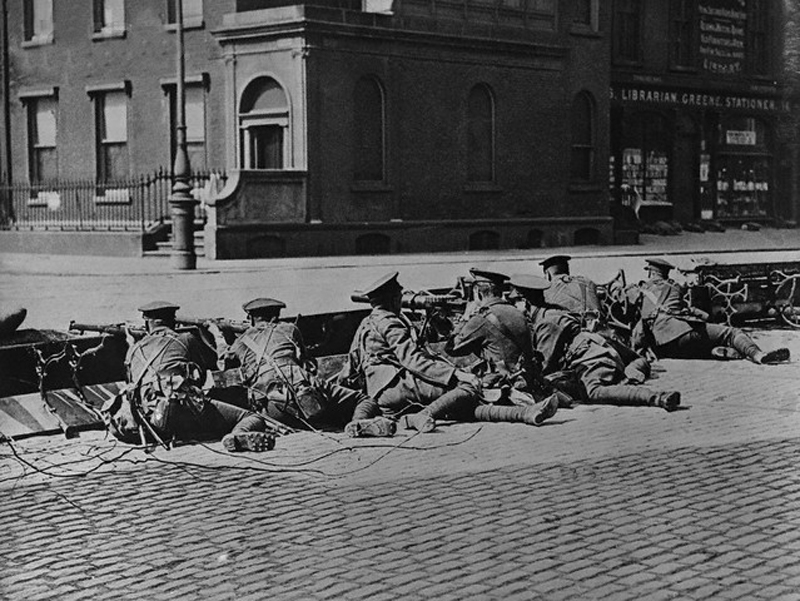
British troops in Dublin (Irish Republican History & Remembrance)
The following year saw the clouds of war darken even further, if possible, casting more and more of the world into gloom. Ireland, the United States, Mexico, and Arabia felt themselves dragged into the swirling maw of war, whether directly or indirectly as a result of the European conflict. Russia landed hammer blows on Turkey in the Caucasus and Austria-Hungary in Carpathia. Germany overran the Allies' new partner, Romania. Turkey, meanwhile, surrounded and defeated a large part of the British force in Mesopotamia.

And two of the most famous and sanguinary Western Front battles (in the large, world-war sense of "months-long conflicts over broad regions") took place: the battle of Verdun and the battle of the Somme.

I'm hoping to read through some large chunks of my Great War library, ones that deal with these last two battles in particular. And break out a few of the following titles.

The Big Push: The Battle of the Somme (ATO)
The Big Push: The Battle of the Somme
Over the Top! Verdun
Verdun: A Generation Lost
Western Front (Verdun)
The 1916 Brusilov Offensive
Over the Top (Brusilov offensive)
Romania: Transylvanian Gambit
Italian Front (the Strafexpedition)
Osmanli Harbi (the Caucasus, Mesopotamia, and Suez)
Suez 1916: The Ottomans Strike
Pershing: The Hunt for Pancho Villa