I have to say, I found this is a ripping wee book. It's the first-hand account of a British
soldier in World War One, from his enlistment until his demobilization.
He was an Other Rank--mostly a private, eventually rising to the
dizzying rank of corporal :-) --and he brings a different perspective to
that of some of the more famous officers' memoirs. He was also a
specialist, trained as a machinegunner in an infantry unit then
transferred to the new Machine Gun Corps (MGC), which collected MG teams into a
single body, then detached them as small elements to support infantry
units (as well as providing support to the cavalry, motorcycle and
armoured car units, and eventually provided MG crews to the newfangled
"tanks"). Coppard is a very observant raconteur, and he speaks feelingly
of the emotions he and other soldiers encountered, but he also displays
the stoicism and good humour with which the British soldier generally
meets his fate whether good or ill. He's a very lucid writer, and for
all he doesn't engage in purple prose or amateur dramatics, he's
readable and thoughtful, providing more than just a bare recounting of
places and dates. If you come across the book and have never read
anything about the Great War, I would recommend it as a well-written
introduction. If you've read a lot about the World War, but would like
to get a glimpse of the trench-eye view, I would recommend it again.
One
thing that struck me, having watched not too long ago the very popular
Downtown Abbey television series, was what Coppard remarked as the most horrible
experience he endured. He suffered through uncountable bombardments,
endured cold days and nights, wet or even flooded trenches, foul
rations, incessant lice, and other privations that would make most of us
curl up and cry for mummy. But what he remarks on being the most
unpleasant and hateful period of his service was a time he spent in a
clean, dry, warm rear-area hospital. One of his mates accidentally shot
him in the foot with a revolver as they were assembling for duty one
morning. He was sent to a field dressing station and then to hospital.
En route, he was marked down as being suspected of suffering a SIW or self-inflicted
wound. The hostility, the ostracism, the cold and brutal treatment he
received as a suspected SIW hurt him more then the wound and caused him
more distress than any physical suffering. Once the full account of the
event was passed back through the reporting chain, the difference was
night and day; he was warmly and kindly treated by everyone who had
shunned him or supplied the barest of attention before. Anyone who saw
DA can rest assured that the incident in which a relative of one of the
characters is reported shot as a deserter was not far off in its depiction of how such news would be received. On the other
hand, I always found the ease with which one of the other characters got
himself wounded and sent home with no suspicion on the part of his
comrades as to the nature of his injury... I still find that far too
convenient a plot device.
I'll add a bit more about what I found interesting later, perhaps over the weekend. And stick in a few photos. :-)
Friday, May 31, 2013

Thursday, May 30, 2013
Normal Service to be Resumed Shortly
Three posts out of seventeen apologising for a gap in posts is not a good thing! But various events have kept me from giving The Hissing Fuse the attention it deserves, which will hopefully be shortly remedied.
Previews of coming attractions include:
Previews of coming attractions include:
- I should soon finish George Coppard's With a machine gun to Cambrai; for a small volume, it's taken me a great time to read it, but I've enjoyed it a good deal. It's very lucid and heartfelt, and in other circs it would be a very quick read, so I highly recommend getting your hands on a copy, gentle reader.
- Likewise, Foch: Supreme Allied Commander in the Great War by Michael S. Neiberg is a pretty quick read, and I should have that finished off before too long. If I didn't read so many things at once...
- Meanwhile, Roundwood's World has had several new posts on his lovely poilus and some of their reporter friends.
- Also, the Lardies' Summer Special is out and has a piece on late war British infantry tactics, with accompanying scenarios.
- I have a large (large) painting project to work on this summer, which I am hoping to chronicle for you, gentle readers. Perhaps one of my last painting projects for a couple of years...
- And to get me in the mood for that, I'm planning some rainy day soon to have a Great War marathon viewing session. I have shrinkwrapped copies of Capitaine Conan and Joyeux Noel to break open as well as a been-watched-but-still-good Paths of Glory and (on the magic Internets/Roku box) Beneath Hill 60 and a few other choice examples of the film-maker's art.
Friday, April 26, 2013
A Tidbit for Friday
One interesting remark I came across in Coppard's memoir was that a Jewish soldier in his regiment was allowed, in the spring of 1916, a week's home leave to attend Passover services. Many soldiers in the unit, according to Coppard, had not had any home leave since arriving in France. Coppard had, himself, been given about a week's compassionate home leave when his stepfather died at the beginning of 1916. That had been his first time back in England since embarking at Folkestone on 1 June1915.
In passing, I remark that Coppard had clearly read Robert Graves's Goodbye to All That, and read it very closely, before writing his own account of the war. Several times already (I'm about two-thirds through the short volume) he has mentioned Graves, either confirming his observations, remarking that their experiences were different, or questioning whether Graves quite understood some of the things he saw.
He has presented a pretty thorough impression of the attitudes towards the enemy in his unit. It began largely with a rather cautious dislike, the sort of instinctive but not very personal hostility that soldiers might have to an enemy they had not personally encountered. By the time they reach the winter of 1915/1916, however, he and his comrades had suffered enough from the attentions of the foe that there was no question of a Christmas Truce and, in fact, a positive willingness to take opportunities to kill the enemy. And when a group of German soldiers, under the pretense of surrendering, approached the British lines close enough to mount a devastating grenade attack, Coppard and others resolved simply to shoot any enemy in future that appeared to be attempting to surrender.
In passing, I remark that Coppard had clearly read Robert Graves's Goodbye to All That, and read it very closely, before writing his own account of the war. Several times already (I'm about two-thirds through the short volume) he has mentioned Graves, either confirming his observations, remarking that their experiences were different, or questioning whether Graves quite understood some of the things he saw.
He has presented a pretty thorough impression of the attitudes towards the enemy in his unit. It began largely with a rather cautious dislike, the sort of instinctive but not very personal hostility that soldiers might have to an enemy they had not personally encountered. By the time they reach the winter of 1915/1916, however, he and his comrades had suffered enough from the attentions of the foe that there was no question of a Christmas Truce and, in fact, a positive willingness to take opportunities to kill the enemy. And when a group of German soldiers, under the pretense of surrendering, approached the British lines close enough to mount a devastating grenade attack, Coppard and others resolved simply to shoot any enemy in future that appeared to be attempting to surrender.
Tuesday, April 23, 2013
All Quiet, Apart from Scouting Reports
I'm continuing to read Anthony Saunders's Raiding on the Western Front, George Coppard's With machine gun to Cambrai [sic], and R. Derby Holmes's A Yankee in the Trenches. What strikes me most from the latter is the sheer misery of life in the trenches. This is hardly a surprise, given all that one reads and hears in general history about the war, but it should be emphasized that this is not one of the elements exaggerated by the broad-brush and traditional popular histories.
Both describe the rather miserable conditions to be found in those front-line British trenches without proper bunkers, where scrapes or perhaps slightly more commodious billets, still scarcely more than a large holes in the trench side, were dug. Forget some of the pretty pictures from later periods, or from further to the rear, where deep bunkers with walls, ceilings, floor, even rough furniture and venting systems are to be seen. These were just the sort of "nasty, dirty, wet hole, filled with the ends of worms and an oozy smell" that JRR Tolkein mentions in The Hobbit and with which the author was probably familiar himself during his service on the front line in 1916.

Both recount episodes where they were stationed in trenches that were either waterlogged or entirely flooded, with water (or, more properly, thin mud) up to their knees, hips, or waists. At one point, Coppard and his fellow machinegunners have to wade out to a small island which forms their forward gun position
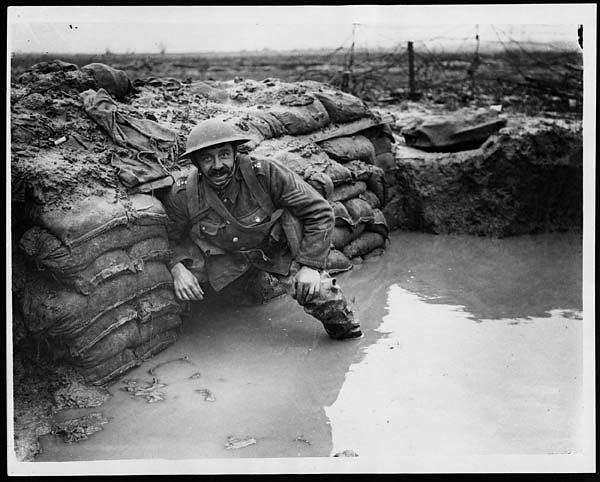
Both encounter that staple of trench horror, the ever-present remains of fellow soldiers (of both armies), too omnipresent to remove for proper burial. As Coppard says, "So long as we were alive, we had to go on living, but it wasn't easy with the dead sandwiched so close to us. We took our meals and tried to sleep with them as our neighbours. Amid laughter and bawdy stories they were there."

Nor is the sheer incomprehensibility of actions taken at the command of higher headquarters blown seriously out of proportion in popular history. Several passages in Coppard's relation bear this home. One is his description of conditions in the Hohenzollern Redoubt in September 1915. Essentially, it was "a mass of pulverised dirt, ... no more than three or four acres" in size, with no visible value to either side, a moonscape of craters from artillery and exploded mines, almost indefensible, but which one side attempted to hold and the other side to possess, at the cost of hundreds, maybe thousands of lives.

In another example of somewhat incomprehensible activity, an artillery FO arrives, directs distant artillery to fire on a target behind the nearest enemy positions, and then departs. Of course, retaliatory enemy fire rains down on the front-line infantry who had merely served as bystanders.
.jpg/400px-German_Barrage_Fire_at_Night_(Ypres).jpg)
What strikes me most from Saunders is the number of interesting actions that could be turned into wargame scenarios, and what a small proportion of the actual fighting they represent. An overwhelming amount of the combat activity that took place when troops were in the trenches was either simply random or near-random exchanges of fire or operations that might be more suitable as the subject of a roleplay episode or map exercise/kreigsspiel than a straight table-top battle. Patrol actions, especially, didn't have the sort of direct conflict that makes a good tabletop scenario, unless they went badly wrong. I'll provide a link here to a patrol report from the Royal Highlanders of Canada from 1916. It's an interesting expedition and certainly brought back useful intelligence, but the patrol leader was very careful to avoid contact and bring his men, and their intelligence, back in safety to their own lines. This could be a good one-sided exercise moderated by an umpire, but it wouldn't make for anything worth putting out terrain and figures.
Thursday, April 18, 2013
Life gets in the way!
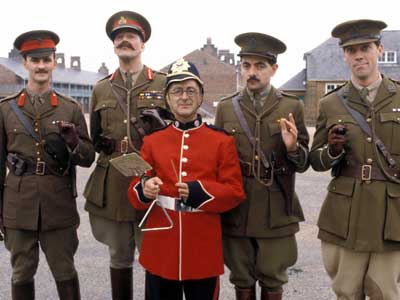
Apologies to my hoard of readers (both of you ;-) for the break in communication. German shelling broke the telephone line from the OP in the forward sap. Or General Melchett had another smoking party in the officers' mess and now we have to get the cleaners in, replace all the furniture, and restock the Dow 1896 port.
Normal service should resume shortly.
Tuesday, March 26, 2013
"...the gun, however, had been removed..."
Last weekend we had the opportunity to recruit another member to our section of Mud and Blood enthusiasts. My friend Ash has played other wargames with us a couple of times, and he was up to trying something new. Mr Sherwood and I gave him a brief run-through on the basics of M&B and of simple infantry tactics, and then he was given command of a raiding party (with Mr Sherwood acting as his trusty senior NCO...)
For the event, I had put together a simple scenario that I hoped would be a fairly painless introduction to the rules, providing enough challenge to be fun while not being so brutal as to discourage the beginning player. As the subject, I picked the very first ever trench raid, as mentioned by Anthony Saunders in his Raiding on the Western Front.
This action took place in early November 1914 near Festubert. A German unit had pushed a sap forward towards the British lines and placed a machine-gun there "which was causing annoyance", according to one source. The 2nd Battalion, the Black Watch staged a small attack to capture or destroy the gun and its position.
Ash and Bryan had two sections of Highlanders to clear the sap and its supporting trench. They advanced side by side separated by a road, one section crossing an open field and taking cover in a tree line while the second section occupied the ruins of a farm about 50-60 yards from the sap.
The Germans had a good deal of trouble with their MG. They fired off a couple of bursts at one section of Scots as they advanced to the treeline, but after dropping a couple of kilties, they suffered a stoppage that lasted through the rest of the game. The supporting gruppe of riflemen did their best to stave off the inevitable, but with the MG out of action, the Germans were like the Lady of Shallot--their doom had come upon them.
I had tried to give the British an edge (justified by their success in the historical event) by including both the Up and At 'Em and Mad Minute cards. These proved crucial, as they allowed the British to get in position under cover and to pour a steady stream of fire onto the German positions that even their trenches could not wholly shelter them from. Eventually, the Highlanders just shot the Germans to pieces, with the German NCOs being shot down last, one by one, as they tried desperately to get their gun back in action (once the German units were gone, I allowed the British to shoot directly at the German Big Men). The Hun lost the MG, the sap, and the trench, with all ranks wounded or killed. The British took four casualties, much the same as in the historical raid.
I was quite happy with the result. It was intended to be a British win from the beginning, but I was impressed that the players managed (with help from the dice gods) to keep so close to the original British casualty figures. I think the scenario works well as a starter piece, a short scenario with the beginner as the British and an experienced player in the German role (and, if necessary, acting as umpire--it's not about winning and losing, so he can stand to be impartial). We skipped out on using blinds and spotting in our game, so as to limit the complications, and since they would be likely to be of short duration in any case.
Incidentally, on digging around for more information on the original action, I found a brief passage in Mereweather and Smith's The Indian Corps in France that describes the action and gave me an additional piece of information.
Another account (A History of the Black Watch (Royal Highlanders) in the Great War, 1914-1918, A.G. Wauchope, ed.)says
So, in fact, our stoppage had had a fairly historical effect--the original German defenders had not had the advantage of an MG to defend themselves with--and neither did our fictional Germans!
I'll publish the scenario here as soon as I can format it properly. Here's the scenario.
For the event, I had put together a simple scenario that I hoped would be a fairly painless introduction to the rules, providing enough challenge to be fun while not being so brutal as to discourage the beginning player. As the subject, I picked the very first ever trench raid, as mentioned by Anthony Saunders in his Raiding on the Western Front.
This action took place in early November 1914 near Festubert. A German unit had pushed a sap forward towards the British lines and placed a machine-gun there "which was causing annoyance", according to one source. The 2nd Battalion, the Black Watch staged a small attack to capture or destroy the gun and its position.
Ash and Bryan had two sections of Highlanders to clear the sap and its supporting trench. They advanced side by side separated by a road, one section crossing an open field and taking cover in a tree line while the second section occupied the ruins of a farm about 50-60 yards from the sap.
The Germans had a good deal of trouble with their MG. They fired off a couple of bursts at one section of Scots as they advanced to the treeline, but after dropping a couple of kilties, they suffered a stoppage that lasted through the rest of the game. The supporting gruppe of riflemen did their best to stave off the inevitable, but with the MG out of action, the Germans were like the Lady of Shallot--their doom had come upon them.
I had tried to give the British an edge (justified by their success in the historical event) by including both the Up and At 'Em and Mad Minute cards. These proved crucial, as they allowed the British to get in position under cover and to pour a steady stream of fire onto the German positions that even their trenches could not wholly shelter them from. Eventually, the Highlanders just shot the Germans to pieces, with the German NCOs being shot down last, one by one, as they tried desperately to get their gun back in action (once the German units were gone, I allowed the British to shoot directly at the German Big Men). The Hun lost the MG, the sap, and the trench, with all ranks wounded or killed. The British took four casualties, much the same as in the historical raid.
I was quite happy with the result. It was intended to be a British win from the beginning, but I was impressed that the players managed (with help from the dice gods) to keep so close to the original British casualty figures. I think the scenario works well as a starter piece, a short scenario with the beginner as the British and an experienced player in the German role (and, if necessary, acting as umpire--it's not about winning and losing, so he can stand to be impartial). We skipped out on using blinds and spotting in our game, so as to limit the complications, and since they would be likely to be of short duration in any case.
Incidentally, on digging around for more information on the original action, I found a brief passage in Mereweather and Smith's The Indian Corps in France that describes the action and gave me an additional piece of information.
Before dawn on the same day, a similar raid on a smaller scale was carried out by the 2nd Black Watch, with the object of capturing or destroying a machine gun which was tormenting our men. Captain Forrester with twenty men rushed the German trench, and had a hand-to-hand scrimmage with the enemy, of whom they killed ten. The gun, however, had been removed, and the party were lucky to get back to their own trench with only Captain Forrester and one sergeant wounded.
Another account (A History of the Black Watch (Royal Highlanders) in the Great War, 1914-1918, A.G. Wauchope, ed.)says
The chief incident in the left section was a night raid made on the German trenches by some twenty men of No. 2 Company under Captain Forrester, with the object of destroying a machine gun which was causing annoyance from a sap pushed up close to our line. The raid took place on November 9th. Captain Forrester was wounded through the lungs as the raid started, but continued to lead his men, who reached the German trenches and killed ten of the enemy in hand-to-hand fighting; the machine gun had, however, been removed. The party returned with Captain Forrester, Sergeant Wallace, and one private wounded.
So, in fact, our stoppage had had a fairly historical effect--the original German defenders had not had the advantage of an MG to defend themselves with--and neither did our fictional Germans!
Wednesday, March 20, 2013
A few new toys
Among the things I got at Cold Wars were some of the Old Glory WWI figures and a special pack from Great War Minis.

I had heard that the two lines are not terribly compatible, and I have to say that's so. The Old Glory line, while quite nice based on these Germans and some Americans I acquired, are a good bit smaller, possibly true 25s compared with GWM and Renegade, which are more "heroic" 28s. Nonetheless, I think that of one doesn't mix the two in the same units, they can get by in the same force.
In the image above are two Old Glory pieces, in the top left and bottom right. Top left are a pair of kneeling/seated figures, one operating a radio or field telephone, the other taking notes on a pad. The latter could as well be paired with an officer observing through a filed periscope or some such. His base is not nearly as thick as that of the handset man, so I've added a small base under him, which leaves him slightly elevated over the other figure, but more or less on a level.I'll have to do some creative ground-sculpting.
On the bottom right is a chap holding a pigeon, with a nice wicker basket that presumably held the feathery messenger. The set also included a runner with a satchel, who is not in this shot.
The three other pieces are Great War miniatures, and beautiful work they are, too. In the lower left corner is a Granatenwerfer 16, an Austrian spigot mortar adopted by the German Army. The Soldier's Burden has a nice page on it here. The GWM piece comes with a granatenwerfer in two pieces, an operator, and an additional crewman.
I suppose the latter might as well be a support for the central figure, a gunner with a Mauser Tankgewehr M1918, or 13mm anti-tank rifle. He provided a nice excuse to pick up some of the lozenge-shaped bases that Gale Force Nine includes among its inexpensive MDF bases (for sale, alas, only at conventions). In emulation of my hero, Uncle Sid, I've decided to go with these for my WWI forces.
Speaking of these pill-shaped bases, the third GWM set uses one of these to carry a team using the Kleinflammenwerfer, or small flamethrower. The Soldier's Burden has a page describing the German employment of these devices. While initially effective, they became less so once British and French troops overcame their initial shock at the use of fire, and (as mentioned in this piece on firstworldwar.com), the life of an operator was dangerous and, if captured by the enemy, very short indeed.
I also acquired some Brigade Games German sentries (not pictured), some of which are smoking, the slackers! These will be useful for M&B for sure--I might even get them some special bases for their special role.
In addition, with my pre-Cold Wars purchases (thanks to the chaps who bought my old 15mm Franco-Prussian figures!), I now have enough figures for a half-Zug of early war Germans, another half-Zug of late war Germans, and a platoon of Americans. Now to start painting...

I had heard that the two lines are not terribly compatible, and I have to say that's so. The Old Glory line, while quite nice based on these Germans and some Americans I acquired, are a good bit smaller, possibly true 25s compared with GWM and Renegade, which are more "heroic" 28s. Nonetheless, I think that of one doesn't mix the two in the same units, they can get by in the same force.
In the image above are two Old Glory pieces, in the top left and bottom right. Top left are a pair of kneeling/seated figures, one operating a radio or field telephone, the other taking notes on a pad. The latter could as well be paired with an officer observing through a filed periscope or some such. His base is not nearly as thick as that of the handset man, so I've added a small base under him, which leaves him slightly elevated over the other figure, but more or less on a level.I'll have to do some creative ground-sculpting.
On the bottom right is a chap holding a pigeon, with a nice wicker basket that presumably held the feathery messenger. The set also included a runner with a satchel, who is not in this shot.
The three other pieces are Great War miniatures, and beautiful work they are, too. In the lower left corner is a Granatenwerfer 16, an Austrian spigot mortar adopted by the German Army. The Soldier's Burden has a nice page on it here. The GWM piece comes with a granatenwerfer in two pieces, an operator, and an additional crewman.
I suppose the latter might as well be a support for the central figure, a gunner with a Mauser Tankgewehr M1918, or 13mm anti-tank rifle. He provided a nice excuse to pick up some of the lozenge-shaped bases that Gale Force Nine includes among its inexpensive MDF bases (for sale, alas, only at conventions). In emulation of my hero, Uncle Sid, I've decided to go with these for my WWI forces.
Speaking of these pill-shaped bases, the third GWM set uses one of these to carry a team using the Kleinflammenwerfer, or small flamethrower. The Soldier's Burden has a page describing the German employment of these devices. While initially effective, they became less so once British and French troops overcame their initial shock at the use of fire, and (as mentioned in this piece on firstworldwar.com), the life of an operator was dangerous and, if captured by the enemy, very short indeed.
I also acquired some Brigade Games German sentries (not pictured), some of which are smoking, the slackers! These will be useful for M&B for sure--I might even get them some special bases for their special role.
In addition, with my pre-Cold Wars purchases (thanks to the chaps who bought my old 15mm Franco-Prussian figures!), I now have enough figures for a half-Zug of early war Germans, another half-Zug of late war Germans, and a platoon of Americans. Now to start painting...
Subscribe to:
Posts (Atom)