Wednesday, March 2, 2016

Black Contingents in Other European Forces

Tirailleurs Sénégalais in France, 1917 (okayafrica.com)
My previous post touched on African troops in French service. Of course, France was not the only country to employ Black troops (either colonials or home-country citizens). This paper by Christian Koller examines the African contingents in various armies, Europeans' perceptions of them, and the effect of the war on these participants and their cultures. Papers at this conference explored some of the same themes. And another page includes some rare and fascinating photos of Black soldiers in the British and German regular armies (rather than in colonial units).

British African Troops

King's African Rifles corporal and privates (okayafrica.com)
The title of "most famous African unit" to serve in the British forces in the Great War undoubtedly belongs to the King's African Rifles. Originally raised and serving as gendarmes (units with both civil police and military responsibilities), the KAR was expanded again and again during the Great War as the activities of Germany's colonial forces in German East Africa kept the British forces scrambling. By 1918, the KAR consisted of 22 battalions, well over 30,000 men. Disease had claimed an additional 3,000 men and combat more than 5,100 either killed or wounded. The KAR was originally formed in 1902 and replaced a number of other localized units from Kenya, Ugnada, British Somaliland, and Nyasaland (present-day Malawi). The KAR continued in their role as gendarmerie after the war and served around the globe in World War Two, continuing their reputation as brave and skillful fighters.

Other African units, which together made up the West African Frontier Force, were the Gold Coast Regiment, the Nigeria Regiment, the Sierra Leone Battalion, and the Gambia Company. Another unit from East Africa was the Somaliland Camel Corps.

Men of the South African Native Labour Contingent (Mail & Guardian)
South Africans had mixed feelings about the war. Some attempted to overthrow the Union government, and though the initial coup failed, an armed uprising persisted for nearly a year. South African forces fought for Britain in German Southwest Africa and in East Africa; a brigade-sized contingent even served in Egypt and on the Western Front. But only White South Africans were allowed to serve under arms. Black and mixed-race South Africans were only permitted to serve as porters and labourers or in France in the South African Native Labour Contingent, part of the Labour Corps.

Rhodesia (technically two entities, Northern and Southern Rhodesia, both controlled by the British South Africa Company, rather than by the Crown or a dominion government) did not share South Africa's equivocal feelings about the war. Many White Rhodesians joined the British Army or the Royal Flying Corps directly, sometimes forming formal or informal Rhodesian subunits. Others volunteered for the 1st and later 2nd Rhodesian Regiments, all-White units that served in South Africa during the tail end of the rebellion there, then in Southwest Africa and in East Africa.

The Rhodesia Native Regiment on parade in Salisbury (Wikipedia)
Rhodesia also raised first one then two Black African battalions (still led by White officers) for what was eventually called the Rhodesia Native Regiment. These troops served through arduous conditions and with great bravery in the East African campaign. When a contingent of 500 RNR soldiers, discharged and on their way home at the end of the war, reached the capital, Salisbury, they were greeted by a huge celebration, including the senior government minister, the territorial administrator, who gave a speech thanking the troops for their service and crediting them for having helped win the war.

But without question the largest force raised in Africa by the British was the conscripted labour force that supported British operations, the Carrier Corps of 400,000 men from East and Central Africa.

British West Indians

Of course, one significant Black contingent in the British forces were not Africans but troops from the West Indies. The British West Indies Regiment contributed eleven battalions to serve in Europe, in Italy, West and East Africa, and in Egypt and Palestine over the course of the war. The Bermuda Militia Artillery sent contingents to the Western Front with the Royal Garrison Artillery. (The Bermuda Volunteer Rifle Corps, a white unit, also served on the Western Front). And civilians contributed to war loans, bond appeals, and other fund-raising drives, contributing considerable sums especially to the air services. One Caribbean soldier, George Blackman, interviewed in 2002, recounted some of his experiences of harsh labour and sporadic combat.

Black Britons

Arthur Roberts, RSF (The History Press)
And perhaps the smallest, but by no means the least Black contingent in the British forces were those Black Britons who served in the Army, the Royal Navy, and other services lke the merchant marine. The footballer Walter Tull, probably the most famous of these, enlisted, served in France, was commissioned as an officer in the Middlesex Regiment, but was sadly killed in action in 1918. This article from BBC Magazine relates the story of David Louis Clemetson, a Cambridge law student who served as a commissioned officer in the Territorials in Macedonia, then transferred into the Welsh Regiment. He, too, was killed in action in France in 1918. The story of Arthur Roberts, who served in the Kings Own Scottish Borderers and the Royal Scots Fusilier, was a happier one; he survived the war to be demobilized, become a skilled tradesman, marry and raise a family, dying only in 1982. For a general study of Black British experiences of the war, military and civilian, Black Poppies: Britain’s Black Community and the Great War seems to be the most recent and comprehensive account. It is available as a Google eBook, as well as in print.

Belgium and Others

Belgium's Force Publique, another gendarme force with White officers and NCOs and African private soldiers, expanded during the war as it fought the Germans in West, Central, and East Africa. Starting 1914 with 17,000 men in four battalions, the FP expanded to about 25,000 men in 1916 and to 15 battalions by the end of the war with another 260,000 men conscripted as bearers.

Portugal and Spain also raised askari (native troops) in their Saharan and sub-Saharan African colonies, but these saw little action in the war.

Germany

Kamerun Schutztruppen (Deutsche Welle)
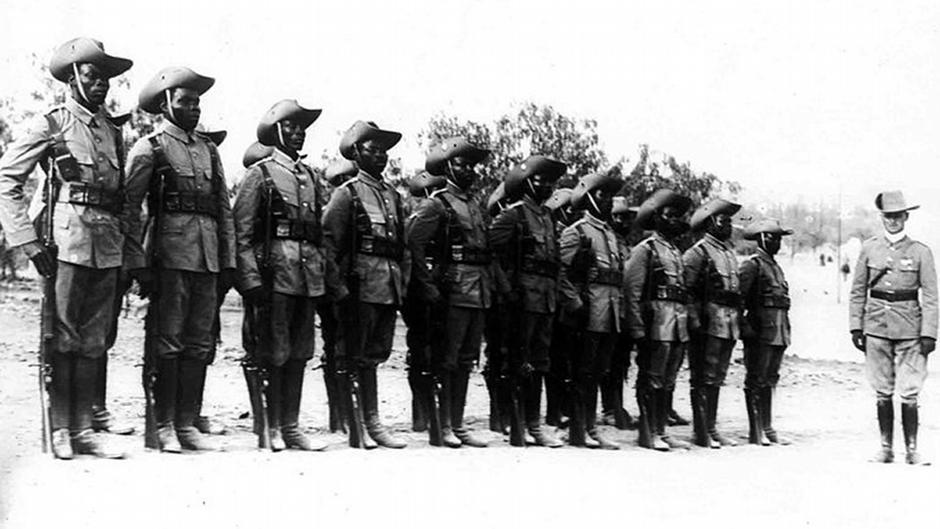
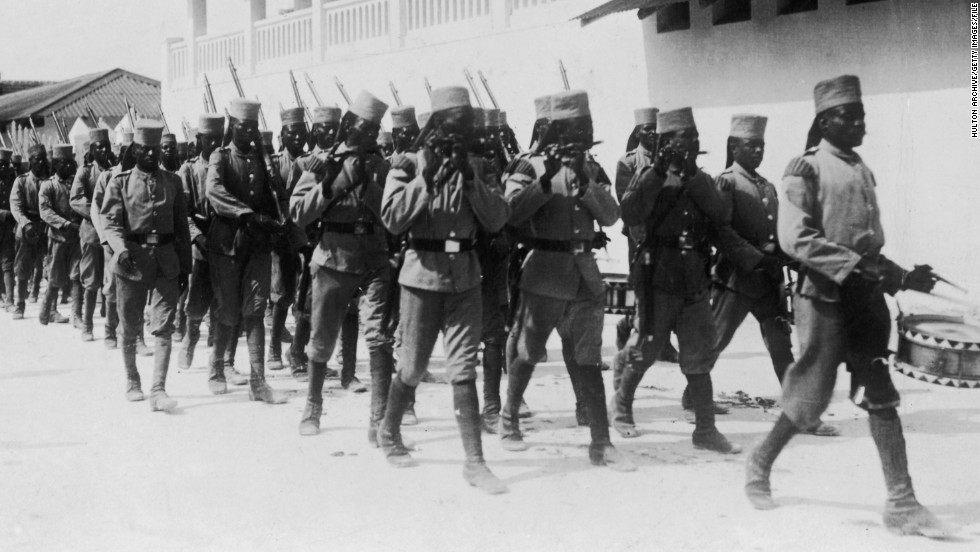
On the German side, the Schuztruppe ("protection force") of the colonies of German West Africa, German Southwest Africa, and German East Africa numbered over 6,300 men, including medical and technical staff. Each colony had slightly different policies; in Southwest Africa, because of Germany's genocidal war with the native Herero population, all ranks in the Schutztrruppe were White--either Germans or disaffected Boers. In West Africa (Kamerun and Togoland), Whites provided the officers and NCOs and Blacks the enlisted ranks.

Schutztruppe soldier saying goodbye to his family (okayafrica.com)
In East Africa, the 14 companies of Schutztruppen included White officers and technical staff, some White NCOs and technicians, but also Black NCOs (three times as many as White ones) and Black other ranks. Each company also had a body of 250 bearers. Companies also had irregular native contingents, called Ruga-Ruga, of comparable size to the companies (150-200 men). An additional 16 companies were raised during the war, as well as eight companies of riflemen (Schützenkompagnies) which were originally formed by White settlers but became of mixed racial composition as time went on. Sometimes numbering only a few thousand men, the Deutsch-Ostafrika Schutztruppen eventually required close to a quarter of a million British, Indian, and African troops to be posted to the East African theater. At the end of the war, the DOS was still operating in the field, undefeated and uncaptured. When news of the armistice in Europe reached them, they laid down their arms. In 1919, they were honored with a march through the Brandenburg Gate in Berlin (only officers were able to participate, as the troops had been demobilized in Africa). In 1964, the German government voted to provide back-dated pay to all askaris (native troops) of the Schutztruppe who could present proof of service. As a commmentor to the previous post noted, the test that was eventually settled on was asking the claimants to perform the Schutztruppe manual of arms (weapons-handling drill). All 3250 who showed up to apply performed the drill correctly, more than 45 years after being demobilized.

The War in Africa

The centennial of the Great War has prompted a number of retrospective examinations of the effect of the war on Africa and of Africans' contributions to the war efforts of their colonial rulers. One effort to document the war's effect on the continent is World War I in Africa. The website provides some background to the project, founded by a French geographer and a Tanzanian cultural activist, but overall the site appears sporadically maintained. Their Tumblr blog appears to be updated more often.

Another source is the Great War in Africa Association.

Other pages include:
For a broad review of the Great War campaigns across the African continent, Wikipedia's page is as good a place to start as any. In future posts, I'll look at some different African campaigns individually.
Schutztruppe soldiers in Dar es Salaam (CNN)

Monday, February 22, 2016

February: Verdun and French African Troops in the Great War

German grenadiers and flamethrowers at Verdun. (http://www.wereldoorlog1418.nl)
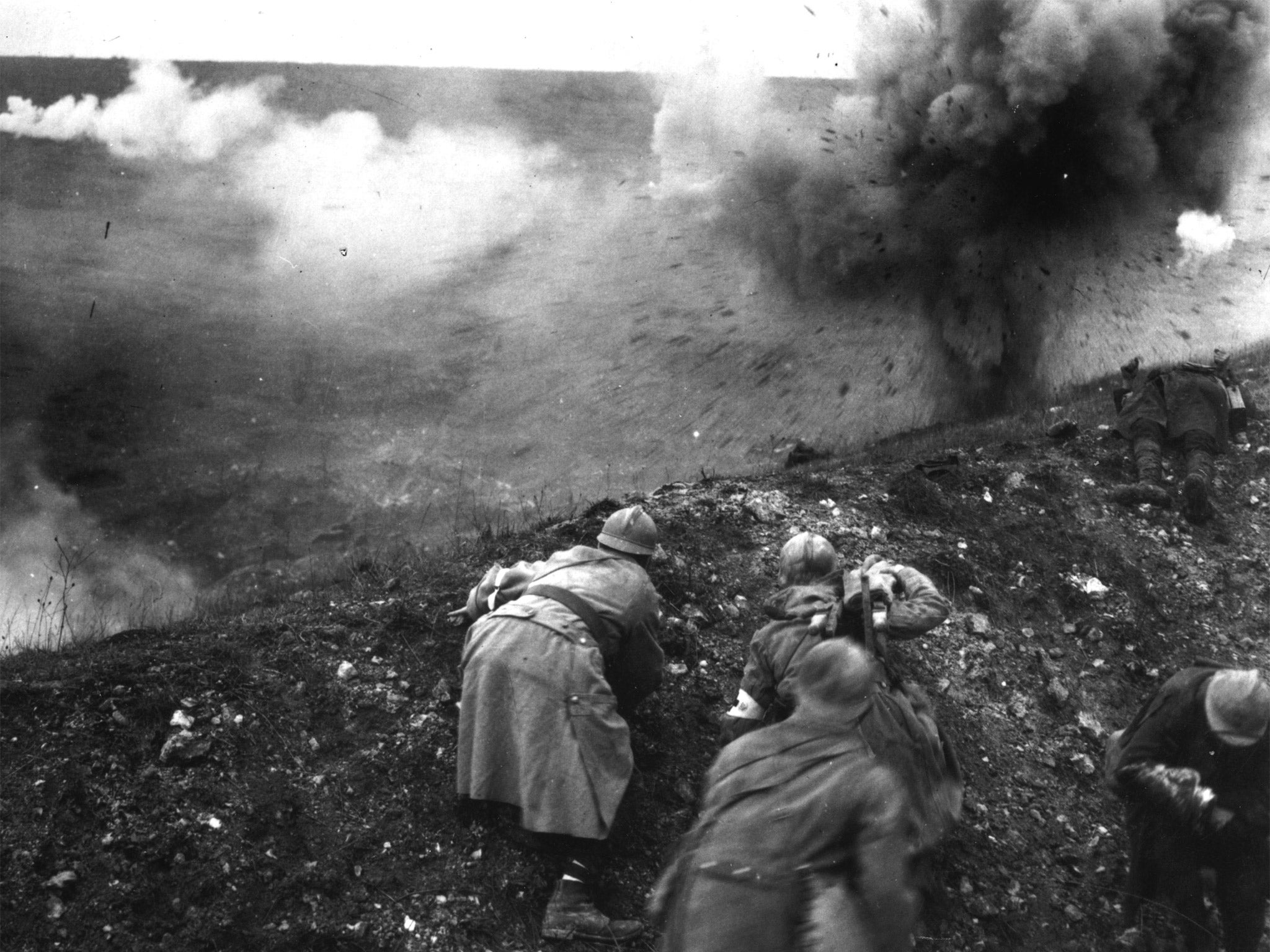
Yesterday marked the 100th anniversary of the beginning of Fall Gericht, the German operation to capture the French city of Verdun. Or, more accurately, to draw the French Army into a battle of attrition over the city that would weaken it to the point that France could be induced to conclude a separate peace, leaving its allies Russia and Great Britain to fight on alone or concede victory to the Central Powers.

Instead, the battle would prove almost as costly to Germany as to France. And it drew off French support for the year's planned offensive by the Allies on the Western Front, weakening it and leading in some part to the slaughter that was the Somme. But even with the massive casualties they suffered, the Allied forces on the Somme made some headway over the course of the ensuing months. By the end of the year, despite hundreds of thousands of casualties, the Germans had captured almost no ground around Verdun that the French had not been able to recapture, and in seeking to bleed France white, the Germans had taken staggering losses of their own. Instead of crushing French national morale, the Germans had created of the city a heroic martyr. France issued all troops who served in the region a special medal; the lone supply route into the city was christened "the Sacred Way", and even the villages destroyed in the battle became sanctified as sacrifices to the preservation of France. A public drama, part living history, part secular passion play, is produced every summer to commemorate the siege.

French troops under fire at Verdun. (Getty)
If you have sufficient French, I would recommend the centenary website set up by the French government and a group of regional and historical associations, and/or this site set up by the tourism authority. For an English language introduction, this website from Nederland provides both a brief overview and more detailed accounts of events. Of course Wikipedia has an exhaustive set of articles on the campaign.

February here in the United States is also African-American history month. In 1916, American was still sitting out the war. The brave men of America's 92nd and 93rd Divisions, including the Harlem Hellfighters of the 369th Infantry, the Black Devils of the 370th, and the Buffalo Soldiers of the 371st and 372nd who would later serve in France's Red Hand Division were all still on America's shores.

But France had many African heroes in 1916. France's colonial empire served as a recruiting ground for a large segment of the French armed forces, and unlike Great Britain, France was not chary about bringing its black African soldiers to fight in Europe against white European foes. In fact, France had counted on La force noire to help defend metropolitan France since 1914, and had included both sub-Saharan African troops and North African troops in its strategic force planning since the previous century, recognizing that with the birthrate of metropolitan France unable to keep up with that of Germany, the empire would have to help defend the mother country. France also brought troops from its Southeast Asian dominions to help defend France.

French African troops. (ww1centenary.net)
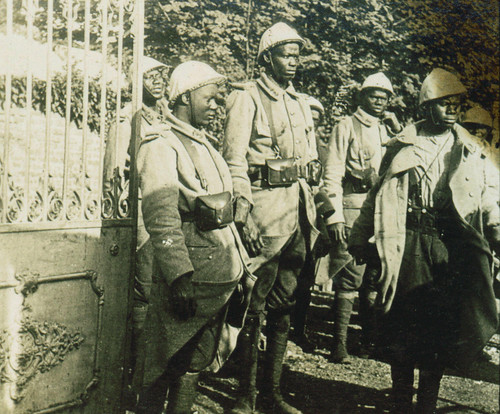
French troops from sub-Saharan Africa were collectively know as Tirailleurs Sénégalais (though not all of them came from Senegal). They served not only on the Western Front but as part of France's contingent in the ill-fated Dardanelles campaign and as garrisons in various overseas territories. They provided part of the occupation army that secured former German territory after the war. The Regiments Tirailleurs Sénégalais (RTS) continued to serve France and fight loyally in her wars until 1964, seeing action in World War Two, Indochina, and Algeria.


In June 2006, the African contribution to the defense of Verdun was recognized by the opening of a memorial to the Muslim troops--Algerians, Moroccans, Senegalese, and others--who fought for France in the Great War and especially those who died in defense of Verdun. Just last year, the president of Mali, visiting France, made sure to visit Verdun and pay tribute to the sons of his nation who had fallen in France.


Edited to add: I had the following exchange with a reader offline, and I thought it would  enhance the post, so with his permission I'm including it.

Andrew: Interesting that you mention this, as it is strangely under reported. I had never heard about African troops until I saw a bit about them in a documentary several years ago. Besides telling their story, one thing I've never seen any cogent discussion about is the effect of their service *after* they returned home. Before WWI, the colonial European powers looked pretty invincible to the colonials. After having served in Europe and fought Europeans, I suspect the mindset back in those colonies changed for those returning veterans; that aside, they returned home as trained, seasoned troops with tactical and organizational knowledge. The usual narrative is that the European powers bled themselves out in WWI which set the stage for colonial independence movements; but I suspect that colonial veterans of the Great War may have played as much of a part when colonial independence movements took off a generation later.

The Hissing Fuse: There's been more discussion in recent decades of the effect of the wars on those countries. I'm hoping to do a couple of follow-up posts, as I ran across a lot of interesting resources on the web.

Plus, this only briefly touched on African troops in French service. Of course, the British and Germans had large bodies of African colonial troops as well, and the Brits recruited a good many men in the West Indies, both in military and civilian roles.

None of which touches on the European use of South Asians, Southeast Asians, and East Asians, both as soldiers and laborers. One interesting site I ran across covers a good many of these topics at once. Called "War and Colonies, 1914-1918", it catalogues a conference and exhibition of the same name.

Andrew: On a related note, one of my favorite anecdotes from WWI is the decision of Germany to pay back benefits to Askari veterans who served under von Lettow-Vorbeck. Many who reported to claim benefits had no record of their service, but even decades later were able to flawlessly perform the manual of arms given German commands. No good direct link in English, but it's mentioned with sources in the Wikipedia article for von Lettow-Vorbeck here and in a German article in a 1975 issue of the magazine Der Spiegel here.

Wednesday, January 27, 2016

Looking Back at 1915, Looking Forward to 1916.

1915 (a brief timeline)
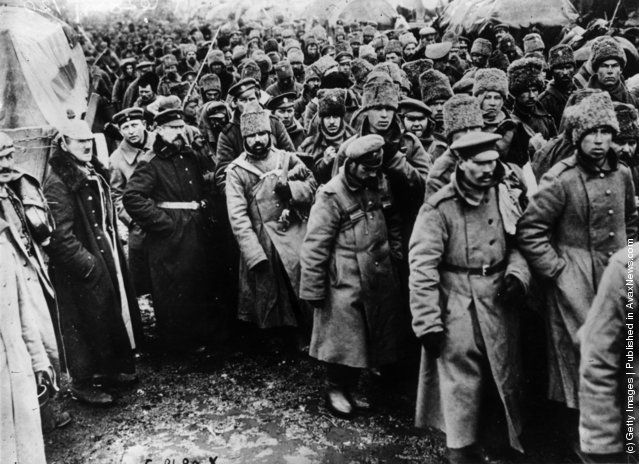
Russian POWs in the Masurian Lakes Campaign (Great War Project)


I never finished my overview of events in 1915. Baldly put, the Western Front, despite the first mass use of poison gas, was a gruesome stalemate, but not the hecatomb it would become in 1916. Several campaigns were begun, sputtered, and went out; the Second Battle of Ypres was perhaps the most notable.

The Eastern Front saw more movement, with fighting in the Masurian Lakes of Prussia, and in Galicia and Poland proper. First the Russians suffered disaster, then the Austrians, then the Russians again, and the year ended with the Tsar taking over command of the war from the generals.

In the Mediterranean, 1915 saw the bloody and eventually pointless Allied invasion of the Gallipoli peninsula of Turkey. Italy, lured by promises of increased territory, betrayed its pre-war allies and declared war on Austria-Hungary, sparking the repeated and useless battles of the Isonzo. Allied forces also landed in Macedonia in October, opening up a mini-front that almost immediately fell into senescence as they failed to advance far from their base at Salonika.The British campaign in Mesopotamia, that had begun in late 1914, crawled slowly forward, with the British winning several victories that gave them cause to hope the region could be subdued in the next year.

Artist's representation of a zeppelin raid (Ian Castle's Zeppelins, Gothas and Giants)
The war expanded into new dimensions, as Germany's zeppelins began bombing raids on the United Kingdom. And Germany declared a blockade of the UK as well, seeking to enforce it with attacks by its fleet of u-boats.

Parts of my Great War-game collection that bear on events in 1915:

Western Front (Artois)
In Flanders Fields (Second Ypres)
Loos: The Big Push
Masuria: Winter Battle 1915
Galicia: the Forgotten Cauldron
Gorlice-Tarnow Breakthrough
Jassin 1915 (the East Africa Campaign)
Serbia the Defiant (a second year of fighting sees the Serbian Army driven from their country, if not defeated)
The Italian Front (First Isonzo)
A Fatal Attraction: The Gallipoli Campaign
Osmanli Harbi (the fighting in Gallipoli, Mesopotamia, and Macedonia)
Zeppelin (the air war in Britain)

1916 (a brief timeline)


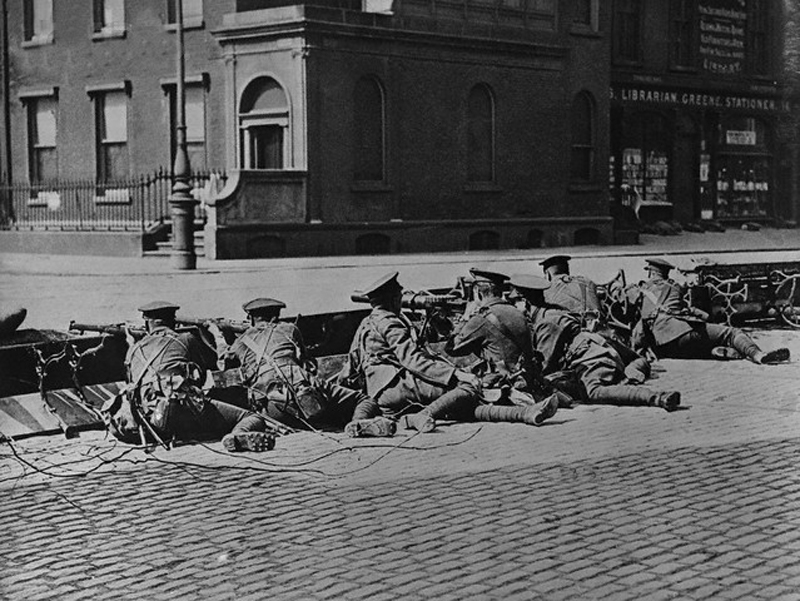
British troops in Dublin (Irish Republican History & Remembrance)
The following year saw the clouds of war darken even further, if possible, casting more and more of the world into gloom. Ireland, the United States, Mexico, and Arabia felt themselves dragged into the swirling maw of war, whether directly or indirectly as a result of the European conflict. Russia landed hammer blows on Turkey in the Caucasus and Austria-Hungary in Carpathia. Germany overran the Allies' new partner, Romania. Turkey, meanwhile, surrounded and defeated a large part of the British force in Mesopotamia.

And two of the most famous and sanguinary Western Front battles (in the large, world-war sense of "months-long conflicts over broad regions") took place: the battle of Verdun and the battle of the Somme.

I'm hoping to read through some large chunks of my Great War library, ones that deal with these last two battles in particular. And break out a few of the following titles.

The Big Push: The Battle of the Somme (ATO)
The Big Push: The Battle of the Somme
Over the Top! Verdun
Verdun: A Generation Lost
Western Front (Verdun)
The 1916 Brusilov Offensive
Over the Top (Brusilov offensive)
Romania: Transylvanian Gambit
Italian Front (the Strafexpedition)
Osmanli Harbi (the Caucasus, Mesopotamia, and Suez)
Suez 1916: The Ottomans Strike
Pershing: The Hunt for Pancho Villa

Friday, January 15, 2016

Closing the Books on 1915: New Games, Part Four

Quick! I've got to finish off reporting on 2015 before 2016 gets any older! Last but not least in my tally of Great War games from last year, the operational scale games.

Let's start off with the games I can say the least about, because there's not much information or opinion on them out there yet. First in that category should be White Dog Games' The Russian Empire Strikes Back: Lodz 1914, since I can tell you only the barest details about it. It features an 11"x 17" map, 88 counters, and an eight-page rulebook, which includes provisions for solitaire play. Michael Kennedy designed the game, which appears to be very fast playing, featuring a swirling winter battle on the Great War's Eastern Front. It has one rating (a 9) on BGG.

Next up would be Fateful Days: Marne Campaign of 1914 is one of ATO/TPS's Pocket Battle Games, games whose map, counters, and rules are all printed in on a card the size of an old-fashioned postcard, making them the perfect promotional piece and an easy way for a designer to get an idea out in the marketplace. It's designed by the incredibly prolific Paul Rohrbaugh. I have a stack of the Pocket Battle Games, but I don't have this one, so I can't give a report on the rules of how it plays. Four people have rated it in BGG: two 7s, a 6, and a 5.

Third in this category is Decision Games' Lettow-Voerbeck: East Africa 1914-1918. This is one of Joseph Miranda's Mini Series games for Decision, 11"x17" maps with 40 counters and fairly simple rules. Seven BGG users have given this depiction of the fighting in East Africa a mean 6.69 rating. It's an area-movement game, with a card-driven dynamic (what DG refers to as the "Hand of Destiny" system). I have a number of DG's Great War games, but none from this Mini Series or that use their card dynamic.

1914: Germany at War comes from the teeming brain of Emanuele Santandrea, designer at Milan's VentoNuovo Games. It's his first Great War game; the second, 1914: Austria Hungary at War  is expected to hit the shelves in 2016. Santandrea and VentNuovo also published the highly popular bicentenary Waterloo 200 last year, but his bread and butter has been a series if World War Two games. VNG appears to be Italy's answer to Columbia Games, having published a slew of block games, starting with World War Two and now moving to the Great War; they have an inter-war period game, Time of Decisions, slated for 2017. Germany at War gets a 9.06 mean rating from 15 BGG scores. Judging from photos, it's a big, colourful game. I just skimmed some of the playtesting reports, but the fog of war resulting from the use of blocks combines with diceless combat based on strength differential (and some other considerations) to make this--I would guess, a rules-light but strategy-heavy game. I very much look forward to finding a chance to play either this or its Austro-Hungarian cousin. It's worth noting that Germany at War covers just the first four months of the campaign.

The latest entrant in Michael Resch's 1914 series is 1914: Serbien Muss Sterbien (SMS). In the latest installment (preceeded by 1914: Twilight in the East (TiE) and 1914: Offensive a Outrance (OaO)), Resch portrays the opening portion of Austria's invasion of Serbia in 1914. Resch's games are not simple: they provide a highly detailed look at operational warfare waged by the Great War's huge armies, and they demonstrate the extensive research and modeling that Resch undertakes. SMS deals with some fairly arcane and complicated terrain and armies, as reflected by the game's terrain rules and by the sections of special rules for Serbian, Montenegrin, and Austro-Hungarian forces. But the size and scope of the campaign still makes SMS (one 22" x 34" mapsheet and ~500 counters) more approachable than TiE or OaO(each with three or four map sheets and over 2,000 counters). In addition, this title casts some light on geography and combatants not familiar to most wargamers, even many devotees of the war that was spawned by the tensions between the Dual Monarchy and its Serbian neighbour. This game has garnered a mean BGG rating of 7.76 from 20 users.

The last title listed as published in 2015 is GMT Games' Gallipoli 1915: Churchill's Greatest Gamble. This is rather an outstanding fudge, as Gallipoli has not yet been published. However, the publishers have supplied a good deal of information about it (here's a link to the articles on Inside GMT that are tagged for Gallipoli), and it looks like it's going to be a doozy. This will be a huge (three-map, 1,000-counter) game, covering the initial landings on the Gallipoli peninsula and the first three days of fighting. As such, the stalemate of May, June, and July, and the follow-up landings in August at Sulva Bay are left to a later game/expansion. But avid Gallipoliphiles will still have their work cut out for them here. The replays and introductions to the rules provided on GMT's blog have been clear and easy to follow, but they involve quite a lot of detail. The rules appear easy to learn, but there's a lot of tactical detail to appreciate and learn how to effectively manipulate. I expect that players will want to play and replay this as their grasp of the rules develops into a grasp of the way to fight their units in the campaign. Nonetheless, the whole package looks terrifically appealing; I've pre-ordered it myself and can't wait to see it finally come out.

Gallipoli is, oddly, a campaign beloved by history buffs (wargamers included) and one that seems to cry out for the "what if" opportunities that games provide, but one that has been poorly covered. Paper Wars Games published a game on the topic (high level, low counter density) in 1979 called simply Gallipoli that has lived a somewhat obscure life (fewer than 50 BGGers own a copy and only 14 have rated it). And ATO's A Fatal Attraction has been a classic ATO title: a fascinating subject given a highly original graphic presentation and an innovative design (Paul Rohrbaugh again) but crippled by poor writing and development. Even one of its strongest proponents on BGG (David Hughes), who loves the game and has played it against its developer, states in his review that "game just cannot be played using the rules as written". The central part of the command and control rules that determine how and when players can activate units "are impenetrable, contradictory, over-concise, and have confused everyone I know who has played," according to Hughes. The victory conditions are also, apparently, a problem, as the Allied player can manage a win by refusing to land troops, bombarding some Ottoman forts, and, essentially, declaring victory and sailing home. Undoubtedly a better outcome for all involved than thew historical campaign,but hardly a depiction of what happened. One hopes that someday ATO will clean up the rules and make the game more playable.

Thursday, January 7, 2016

Closing the Books on 1915: New Games, Part Three

So, continuing the round-up of 2015 WWI games, the strategic titles. I'll reiterate, these are more "what I can make out about the games from their press and BGG reception" not proper reviews.

1WW: The First World War: This appears to be a small game (11" x 17" map, 140 counters), published by One Small Step Games and published in the second issue of their magazine CounterFact, "journal of professional and commercial wargaming". I can't divine much about it beyond it's size (the map covers Europe from France to the Middle East; as an example of scale, the Franco-German frontier from the Channel to the Alps is five hexes), as there is one score (a 6) on BGG and no substantive comments (only four people are recorded as owning a copy). There's a short discussion on CSW Forum about it (a short discussion? on CSW-F? that says a lot), but so far it's mostly rules questions, very little discussion of the game as such.

The Lamps Are Going Out: Owned (apparently) by even fewer people so far (two, currently, on BGG), and rated a 5 by one user and a 10 by the other, this is another game I can offer little insight on. The title comes from a quote by Sir Edward Grey (British Foreign Minister in 1914 and a man I've always thought it would be fascinating to study, as he was active in British foreign policy for over 30 of Britain's most crucial years). It's a truly strategic area-movement game of low to moderate complexity. Its map covers roughly the same geography as that of 1WW with the addition of an inset map of East Africa; by comparison the Franco-German border is one French area meeting one German one, with another French eastern area bordering the Low Countries. The primary thrust of the game is resource allocation, so it does not surprise me to to read comments by the designer crediting James Dunnigan's World War 1 as an early inspiration to him. A playtest report suggests an interesting and challenging game with historical depth but still playable at a sitting. I'm certainly quite curious to see how this came out. CSW-F discussion ended in late November with the game still in playtest, and Compass Games' website shows it still in pre-order and suggests it is actually being shipped in January, so this is a bit of a fudge as "published in 2015".

Also from Compass Games (but listed as on their site as "released" and with over 140 BGG members owning a copy, it is clearly "published") is the much larger and more complex Balance of Powers. With a mean score of 8.82 over 28 ratings, this is clearly popular with those who have tried it. Balance of Powers covers the war in a much larger way, with maps representing Europe, the Middle East, and East Africa, but on a much finer scale in keeping with its focus on corps-level action. It's designed by John Gorkowski, whose stable of published and unpublished designs is fascinating and runs the gamut from 19th century Central Asian geopolitics to modern naval warfare, from the tactical to the strategic, with a considerable focus on topics related to the Great War. The game has come in for a bit of barracking about its colour scheme (hot pink features, among other shades), but reviews online suggest even those players have enjoyed its play.

No idea why I thought I was going to be able to cover all these games, even briefly, in one post. There will be a fourth and final post covering the operational titles, next time. After taking a look at VentoNuovo's 1914: Germany at War, I've moved it into that category. Despite the text on its BGG page (" game of World War I conflict simulation at the strategic level"), this is clearly an operational game, covering the first four months of combat on the Western Front.


Tuesday, January 5, 2016

Closing the Books on 1915: New Games, Part Two

Ah, well, I didn't get this post in under the wire. I'll finish up anyway. And, to clarify, of course these are just my own observations about what has been published. I can hardly *review* most of these games, as I've only played a few of them.

As I mentioned, thirteen entirely new games on World War I were published in 2015 (at least that I could find in Boardgame Geek). But, to avert ill-omen, let's make it up to fourteen by including GMT's 1914: Serbien Muss Sterbien, as that is essentially a new game using an existing system.

So, of these fourteen, four are strategic in scope (The Lamps Are Going Out, 1914: Germany at War; Balance of Power; 1WW: The First World War); five are operational (1914: Serbien Muss Sterbien; Lettow-Voerbeck: East Africa 1914-1918; The Russian Empire Strikes Back: Lodz 1914; Fateful Days: Marne Campaign of 1914; Gallipoli 1915: Churchill's Greatest Gamble); four are essentially tactical and almost Euro-ish (Wipers Salient, Les Poilus; Les taxis de la Marne; No Man's Land); and two are intriguingly hard to fit into other categories (I, Spy and Wings for the Baron). Here are some comments on the last two sections. Strategic and operational games comments coming in Part Three.

Tactical

Les Poilus has the distinction of being the only game among all of these that I've actually played myself. I saw it in the shops and was intrigued by its artwork and description and felt compelled to buy it. I'm glad I did.It's a cooperative card game for two to five players, who form a squad, mates from the same French village who join up together in 1914 and spend the game just trying to survive the war. Each turn, the squad has to go out on a mission and try to make it back intact. Completing the mission means success, but it isn't as essential as everyone getting back to their unit intact. Characters can be injured physically, but they can also suffer mental wounds that leave them less able to survive future missions. Occasional glimpses of good fortune tantalize the players, but this is a very hard game to win. If *any* of the players is seriously wounded or suffers enough shell shock that they have to be invalided out, the whole game is lost. Players come to depend on each other, and a blow to anyone hurts all of you.

One of the things that's interesting is that while the players represent French soldiers (the poilus of the title), the enemy is the war itself. No German soldiers appear. There are no hills to be captured, pillboxes to be blown up. Threats come from faceless shells, from cold and rain, from barbed wire and mud. Not only are you not fighting each other, you're not fighting anyone else. You're just fighting to survive. 

I played this game a couple of times with a mixture of folks, some of whom are accustomed to wargames and/or familiar with military history and the Great War, others of whom are Eurogame players or not familiar with the war or frequent boardgamers at all. What struck me was that everyone was gripped by the themes of the game, frustrated by its difficulty and compelled to try to bring this bunch of friends through without harm. I'm impressed by how well the designers, developers, and publishers did in creating a game that conveys its messages so well. I'd say this is probably the best new game, on any topic, that I played in 2015. I note it's rated a mean of 7.42 over 1176 scores, which I think is fair praise for it's innovative design and beautiful production values.

Note: The English-language edition was titled "The Grizzled", which seems rather unfortunate. It's an attempt to provide a literal translation of the original title, but it just doesn't carry the same power in English. I would have gone with "Dogfaces" or "Poor Bloody Infantry"--depending on whether an American or British/ANZAC/Canadian audience were intended--to try to get the same motive impact. French soldiers were called "the hairy [ones]" to reflect their tired, dirty, unshaven appearance, but it was a term of affection, and that has a resonance that simply translating the word from one language to another doesn't convey. Plus, English doesn't give adjectives the same leeway to hang out on their own that French does.

Wipers Salient looks in some ways to be similar in theme to Les Poilus. It's a solitaire card game where a player tries to accumulate the means to survive a stint in the trenches in the Ypres Salient. Cards represent support, hazards, missions, and (unlike Les Poilus) the enemy. In a sweet touch, all the artwork on the cards comes from Bruce Bairnsfeather cartoons (for American readers, perhaps the best characterization of BB is "the British Bill Maudlin"). Less than a dozen ratings. I'd like to give this a try.

Les taxis de la Marne is a cooperative game in which one to five players try to fill Paris taxis with mobilized
soldiers and get them to the front. While overall it's another process-management game, I like the idea of theming it to represent military traffic cops trying to get men to the Front to stop the German advance on the Marne. It has only ten ratings so far, but six of them are 7 or 8, so at least some people enjoy it. In contrast to some other games in this section, it seems lighthearted and fun, a counterpoint to the (historically appropriate) gloom of Les Poilus. Less than a dozen ratings.

No Man's Land: Trench Warfare 1914-1918 is the last of the tactical games in my list to comment on. It comes from Ludofolie. It has a small number of scores and even fewer comments. It's clearly an attempt to provide a low-level tactical game that can show the evolution of tactics throughout the war. It sounds as if it may have some difficulty in doing this, but with so little comment so far it's hard to say.

None of the Above

In this category are two unusual offerings. One is I, Spy, a game of pre-war espionage in which two to four players act as spymasters for different European powers. Each starts with the same resources, and each player's allegiance is hidden, only officially revealed at the end of the game, so it has aspects of Diplomacy and of the various "hidden villain" games. BGG players have rated it highly (a mean of 7.58 over 11 ratings), and the balance of text comments seem pretty favourable. I'm not likely to buy it right off, but if it shows up somewhere I can play it, I'll definitely give it a try.

Lastly, the ringer. I should have caught this in my prior post, but Wings for the Baron is actually a re-publication by Victory Point Games of a title originally published in 2007. Be that as it may, I find the concept intriguing, so I want to give it a mention any how. In this game, three to five players act as German aircraft manufacturers supplying the Luftstreitkräfte with new models of combat aircraft for the war. Players use research and design efforts, finances, and espionage to try to win contracts. That's an innovate idea for a game, and it doesn't surprise me to see VPG pick it up and run with it. This I would really like to try.

Wednesday, December 30, 2015

Closing the books on 1915: New Games, Part One

I've sadly neglected this blog, neglect that I hope to repair in the coming year. However, given that 2015 is almost behind us, I thought there might be time to do a few quick wrap-up posts.

For one thing, my last post was a review of what was happening in the war on the Western Front in spring 1915. So a post to review what major events took place during the year, on the Western Front and elsewhere, might be in order.

Since I'm an avid wargamer, it seems that there should be a word or two about the score or more of wargames and game modules that came out in 2015.

If I had the time and resources, I'd like to post on the Great War books that hit the shelves in 2015. I certainly don't have time and space to review even a portion of the; I wish I could even point the way to some decent reviews, but that's bit too much to aim for at this late date.

So, Games...

In 2015, going by Board Game Geek's records, publishers released 19 new games on the Great War, as well as 12 modules or other supporting material.

Six of the items in the supporting material category were new aircraft for the popular flying game Wings of Glory. I can't say much about them, as I haven't played the game much this year, and I've not played with any of the new figures, but they certainly look as gorgeous at those models usually do. Four are new fighters or ground-attack aircraft: the Hannover CL.III two-seater, the Macchi M.5 seaplane, the Nieuport 28 biplane fighter, and the Fokker E.V monoplane fighter. The other two are a bit of a cheat to include for 2015, but they're tremendous news: the "Giants of the Sky" aircraft--the British Handley Page O/400 and German Zeppelin Staaken R.VI heavy bombers. These ginormus twin-engine bombers have joined the WoG tabletop game by means of a Kickstarter campaign that raised six times its original goal. The aircraft models are rumoured to have arrived at the publisher's from the manufacturer a week before Christmas and may be flying around the world even as I write, but I'm not entirely sure they count as being relelased in 2015.

Five more of the "ad ons" are information books for the Great War at Sea system. Since they are all alternate-history products, I'm going to pass on by them. I'm also going to pass on two tactical modules for Critical Hit's "ATS" system (Blasted Woods and Tankschreken!)

So, on to the actual games. Six are repurposing of existing systems or republications, in whole or in part. The imaginatively titled Great War (complete with expansion, cleverly called Tank!) is the latest implementation of Richard Borg's card and miniatures system familiar to players of Memoir '44, BattleCry, Battlelore, and the Commands and Colors series. They're always entertaining games; they don't often feel as if they have more than a passing relation to the history they purport to be about, but in the tired refrain of excuse-makers everywhere, "Any opportunity to get people playing history-themed games [or watching execrably unhistorical historical movies] is a way to teach them about history, right?" Well, yes, but often all it teaches them is wrong. I can't speak to Great War, but I played a lot of Memoir '44 back in the day and, while it was a great deal of fun, I can't say that it seemed as if it taught anyone anything about the history of World War Two except (possibly) the names of some of the battles. Just going by the photos on BGG, this looks to be the same, with opposing trenches right on top of each other, tank on tank combat, artillery deployed on the board, etc.

Another reimplementation is Great War Commander, a repurposing of the Combat Commander system from Chad Jensen and GMT. I have tried several times to like Combat Commander but failed every time.The disconnect between the total randomness of the card-draw system and what it is supposed to represent creates an impassable gap in my willing suspension of disbelief. I have no problem with the use of cards in GMT's other CDGs like Paths of Glory, where they represent the scarcity of operational or strategic resources and cause players endless fits of indecision as they try to spread too few assets over too many problems. But in a tactical game like this, the inability of troops to take a perfectly normal action when in no way hindered by the enemy simply because they don't have the right card...I know I should wave my hands and say "fog of war" and "imperfect command and control" but it just breaks for me. Doesn't for others. De gustibus.

Also in the republication category are First Battle of the Marne from Turning Point (a repub of One Small Step's Miracle on the Marne) and In the Trenches from Tiny Battle Publishing (republication of the game of the same name from Grenier Games). And SPW has published Tannenberg: The Introductory Game as an envoi to their Die Weltkrieg Series. Splitting off Tannenberg from their original Tanneberg/Galicia game pair and selling it as a ziploc with a weblink to video tutorials, SPW looks to give new players and easy way in to their complex (but rewarding) WWI family of wargames.

In a way, even 1914: Serbien Muss Sterbien is almost a reimplementation, as it uses the same system developed for 1914: Offensive à outrance (itself related to 1914: Twilight in the East. But each volume in this series has tackled a different topic; here designer Michael Resch approaches the smaller (though not small) topic of the Austrian war on Serbia, instead of the opening phases of the Great War on the entire eastern or western front. I've not had a chance to play this yet, but I'm very much looking forward to.

Finally, there are the thirteen entirely new entries for this year. Four are strategic in scope (The Lamps Are Going Out, 1914: Germany at War; Balance of Power; 1WW: The First World War); four are operational (Lettow-Voerbeck: East Africa 1914-1918; The Russian Empire Strikes Back: Lodz 1914; Fateful Days: Marne Campaign of 1914; Gallipoli 1915: Churchill's Greatest Gamble); four are essentially tactical and almost Euro-ish (Wipers Salient, Les Poilus; Les taxis de la Marne; No Man's Land); and two are intriguingly hard to fit into other categories (I, Spy and Wings for the Baron). Tomorrow I'll take a look at these.