Friday, August 29, 2014

in the works: Tannenberg 1914

Ludendorff explains the 22.5 Königsberg Corps rules to von Hindenburg.
To kick off my experimental study of the first year of the war, I'll be looking at the battle (camapign, really) of Tannenberg, the first large encounter of Russian and German forces on the war's eastern front. My first effort will be a solo play of GMT Game's Clash of Giants: Tannenberg. I'm looking forward to this, as I've played one of the games in this series before and enjoyed it

As a quick introduction, I can recommend this four minute overview of the events from The Complete Landmark Television Series' World War 1 in Colour. Though the documentary images are indeed colourized in a rather flat, washed out way, the footage is itself still interesting, and the map animations simple but clear.


For a longer description of the battle, I can recommend Wikipedia's article, which covers the operations in quite comprehensive detail (though it curiously fails to mention Russian Northwest Front commander Yakov Zhilinski), while the FirstWorldWar.com website's piece on Tannenberg contains links to biographies of many of the senior commanders, as well as accounts of the engagement by German 8th Army commander Paul von Hindenburg and Russian First Army cavalry corps commander Vasily Iosiforich Gurko.

Russian Bielozerski Regiment relaxing while awaiting the next blog post.
Given that a principal feature of the battle was the failure of the two Russian armies to coordinate effectively (due both to poor technical communications provisions and to major antipathy between the First and Second Army commanders), the Tannenberg campaign seems ripe for a triple-blind kriegsspeil. I've recruited three players who are willing to give it a try, so I hope to be reporting to you, faithful readers, on that project in coming weeks.

Monday, August 25, 2014

two interesting pieces in the news

Two articles that floated past my corner of the Internet seemed worth sharing with my Great War readers.

BBC Magazine ran a short article on the German internment of British civilians at Ruhleben during the war. The rather short and facile piece touched on a few aspects of life in the camp in a reductionist, almost insulting manner. The Beeb seems to have gotten enough annoyed feedback from readers who had relatives in the camp that they ran a second article, featuring biographies of several of the internees. These bios, wholly or in part supplied by information for readers, give a fuller and more detailed look at life in the camp and the different paths that led its inmates there.

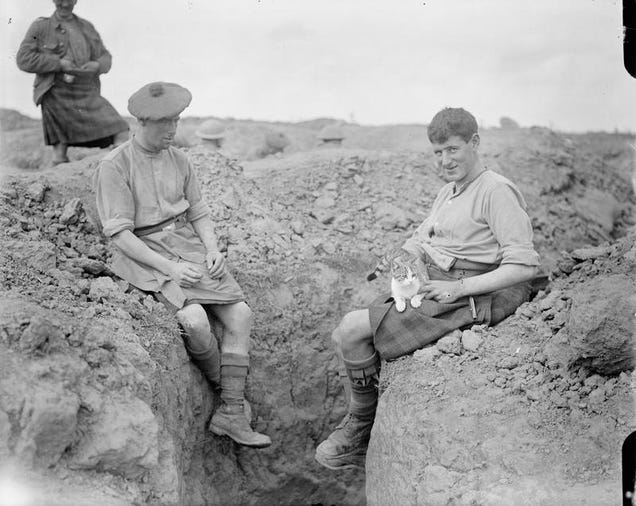
The other article, curiously, comes from the science-fiction/futurist blog io9. This piece concerns the (Allied) cats of World War One. There's minimal text to it, but it features about a dozen and a half photos of cats in various Allied military settings in the Great War, including naval cats, air cats, and trench cats. I rather imagine the Central Powers forces had their cats as well, but no photos of them were included.

Wednesday, August 13, 2014

a quick summary of recent links on the Great War from Society for Military History members

Thanks to a follower of the Society for Military History's Facebook page, here's a link to an article on war art commissioned by the US military during the Great War.

The article, on the Smithsonian website, contains a selection of images from the collection, a link to the digitised artworks, a link to a republication of the collection in book form by Texas A&M University Press, and a link to the New Britain Museum of Art, which houses work by one of the artists who took part in the project.

Other recent SMH posts concerning the Great War have included:

Tuesday, August 12, 2014

I've sadly neglected this blog, posting nothing at all so far in calendar year 2014. Seeing as this month begins the centenary of the Great War, I think it's a fitting time to try and breathe a bit of life into this small journal.

Since this is "a blog on reading and gaming the history of the Great War", I'm going to commit to doing both, as intensively as I can while the rest of life revolves around me, for the next four years. I'd like to say that I'll report on a game and a book every month over that time, but that would be setting an overly ambitious bar. I can promise to deliver a post a month, and I hope I'll manage closer to a post a week on average.

I think that both my game library and my printed library will be more than able to stand up to those requirements, even if my schedule can't. Besides the miniature games I've mentioned here already (TFL's Through the Mud and the Blood, If the Lord Spares Us, Corps Blimey, Algernon Pulls It Off, and the postwar Triumph of the Will), I have Great War Spearhead (now finally available in its comprehensive second edition), Soldat and The Last Crusade, and Wings of War/Wings of Glory.

The boardgame contingent, though, is even larger.

1914: Glory's End (XTR/Command magazine)
1914: Offensive à outrance (GMT Games)
1914: Twilight in the East (GMT Games)
1918: Storm in the West (XTR/Command magazine)
The Big Push: The Battle of the Somme (ATO)
Bloody April, 1917: The Air War Over Arras, France (GMT Games)
Blue Max (GDW Games)
Clash of Empires: August 1914 (3W/The Wargamer magazine)
Clash of Giants and Clash of Giants II (GMT Games)
The Cossacks Are Coming! 2nd Edition (Oregon ConSim Games)
A Fatal Attraction: The Gallipoli Campaign (ATO)
Grand Illusion: The 1914 Campaign in the West (GMT Games)
The Great War in Europe (both the XTR/Command magazine and GMT Games editions)
Jassin 1915 (Khyber Pass Games)
The Kaiser's Battle (SPI/S&T magazine)
Landships (Clash of Arms Games)
Lawrence of Arabia (3W/The Wargamer magazine)
Marne 1918: Friedensturm (Hexasim)
No Prisoners (Decision Games/S&T Magazine)
Paths of Glory (GMT Games)
Pursuit of Glory (GMT Games)
Rock of the Marne (MMP)
Serbia the Defiant/Romania: Transylvanian Gambit (SPW)
Sideshow: The German Campaign for East Africa (SPI/S&T magazine)
To The Green Fields Beyond (SPI)
Togoland 1914 (Khyber Pass Games)
When Eagles Fight (XTR/Command magazine)
World War I (SPI)

Plus, on related post-war topics:

Ataturk! (Khyber Pass Games)
Reds! The Russian Civil War 1918-1921 (GMT Games)
Rise of the House of Sa'ud (3W/The Wargamer magazine)
Rossyia 1917 (Azure Wish Enterprise)
Russian Civil War 1918-1922 (SPI)

I think I have a couple more of Khyber Pass's products, and I have my eye on several GMT P500 games (a new edition of Glory's End and When Eagles Fight coming as a double title; Serbien Muss Sterbien, by the designer of Offensive a outrance; Eagle of Lille, an expansion for Bloody April; Gallipoli, 1915; and Illusions of Glory, an East-Front game using the Paths of Glory model).

Even were I able to review one a month, that would nearly fill up the four years I've alotted myself. We'll see how I get on.

Next up: a review of my bookshelves.

Tuesday, December 10, 2013

a letter from France

As promised some time ago, I've begun transcribing a small cache of letters I've found from my grandfather, who was serving in the AEF in France during 1917 and 1918, to his sister Dorothea C. Paradise, who was living in England during the war.

There are ten letters: four from 1917, six from 1918, and one written after his return to the United States in 1919. I am dismayed to say that someone has disposed of most of the covers; I have only four, and it is guesswork assigning which goes to which letter. I should, I suppose, have begun with the first in chronological order, but this one was the first that I opened when I found the package, and it starts during an artillery bombardment, just after his position has been bombed by German aircraft, so it seemed the exciting in medias res to start off with.

I've added a few comments after the letter.

*****************************************************************************
[superscript at 90* in the upper corner, presumably as a postscript] 
It is splendid about your new gloves! Bravo!!

Hqrs. 56th Inf. Brig.
A.P.O. 744
October 23, 1918

My dearest Dolly

A Boche has just been overhead dropping bombs on us, so I begin to understand your feelings when they did it to you in London. They are rather dirty beasts, aren't they, although when they brought a prisoner in the other night I didn't feel much but pity for him. He was an Alsatian, the son of a French soldier, with three sisters & a girl in Paris. He was helpless and pathetic & it made me more disgusted than ever with the system that dragged him into this heartless, senseless business. It has seemed more unreal & more amazing since I have been here than it ever did before, & at this moment, when the roar of an artillery operation is going on, I can't realize [?] that it is grown men trying to smash other grown men in the lovely golden woods I looked at today. It is too bad that the spirit has to be born again in just this way. If all this labor had been put into something permanent & constructive, what a wonderful place the world would be to live in?

Just at that moment, they came in with a nice letter from you enclosing a very interesting one from Bob. He writes splendid letters, doesn't he? Well, there are two Paradises now in the arena & one just outside it. I wish he could get an assignment to a regiment, because you really do feel better in this part of the world even though it is very much dirtier & rather more dangerous. I shall send you back Bob's letter, because I have no way of keeping it in this land where you travel with a tooth-brush, & quite soon lose that. It seems incredible that people have houses and can have more than three pairs of shoes & two suits at one time if they want to! I left practically everything I own at La Brosse, which is an exceedingly nice place. Did I tell you that I saw my nice Countess in Paris for a few minutes & had a sad parting with her? We are really very good friends, & I like her a lot. She paid me the great compliment of saying that I was "délicat" & gave me an awfully nice cigarette holder. It was great luck from a selfish point of view, to fall in with the de la Chapelles, because we really saw something of France, & have an open house here whenever we want it. I don't suppose I can ask for leave for some time, now, because they will probably put this division into a more active sector before long.

I am too sleepy to know what I want to say & I think that I shall go to bed, & go on tomorrow. We shall probably get retaliation for this artillery fire pretty soon & I had better get my sleep now. Good night, my dear.

The next morning

They bombed us & shelled us & shot machinegun bullets at us & brought in German prisoners all night, but none of it was near enough to make us get up and hunt cover. But it was rather irritating because it wasn't very easy to sleep with our heads ready to drop at any moment. The French on the left picked one of them up with a searchlight & shot shrapnel at him, & it was a very pretty sight.

I shall appreciate the home in America after all this, although I must say the I rather enjoy this stuff. But I am nothing but a civilian in khakhi [sic] -- and I shan't be sorry to be in mufti again. It was a great thing to be born just when I was. Five years later & I should have left lost the greatest experience of generations, & the greatest opportunity. Life here is simple & uninvolved with nothing but Germans & things to worry about, nevertheless, and has distinct advantages.

I had a letter from Wayland in the same mail that brought your. He has been over here for some time -- having flown across the Channel in an aeroplane with some other people. Lately he has been in a hospital in Tours with the Spanish flu, which is one reason you haven't seen him. He liked you all very much, indeed.

Au revoir, donc, ma chérie. J'étais enchanté d'avais recu ta lettre, comme toujours, parceque elle me faisait comprendre un peu de la vie que j'aime si passionement. Toutes mes remerciements.

Mille tendresses,

Burton

OK
N.B. Paradise
2nd Lt., Inf., A.D.C.

[Translation of last paragraph: Goodbye, then, my dear. I was delighted to have received your letter, as always, because it made me understand a little of the life that I love so passionately. All my thanks.

A thousand tendernesses,
]

*****************************************************************************
I have to thank my grandfather, Burton (who, to my sorrow, died in 1942, before I ever had a chance to know him) for his excellent handwriting. It's generally very clear, and the few words that are sometimes tricky I can usually deduce from context.

Factoids: I'm hoping to learn more about the de la Chapelles, of whom I assume his comtesse is one. I'm hoping they are related to le Comte Jean Joseph Xavier Alfred de la Chapelle, who was a bit of a daring adventurer in the 19th century: California Gold Rush man, travelled to Australia, then to Morocco during the French conquest, then participated in and wrote a history of the war of 1870. I don't know whether La Brosse is their home; I'm assuming it is, but both la brosse (the brush) and la chapelle (the chapel) are such common words that it will take much more than Google work to find more information. (Though Google did help me find this entry in the Oxford Dictionary of National Biography: La Chapelle, Victor Octave Xavier Alfred de Morton de, Count de La Chapelle in the French nobility (1863–1931), lawyer and wildfowler, possibly this friend of Burton's.)

I'm pretty sure that the comtesse is the same person who, according to a family story, entertained Burton and his brother Bob (a decorated flyer) at a hunting lodge after to war and, when they sighted a handsome stag as they were out shooting one day said, "Oh, but that is Teodor! We NEVER shoot Teodor!"

I'm not sure who Wayland was, other than to presume he's a family friend (it's not a family name that I recognize).

I'm interested to see if NBP's attitude towards the war remains the same. I came across some stuff he wrote while he was in training back in the States, and it's pretty Boys Own Paper bumpf about freedom and humanity and fighting the beastly Hun. I don't know if this rather starry-eyed view of the war survived whatever front line experiences he had. 

Edited to add: I'm pretty sure, by the way, that the last text block, which is written in the bottom left corner of the last page, is the "passed by censor" mark. Which suggests that he was taking advantage of his position as an aide de camp to the division commander to "censor" his own letters. Tricky bugger. :-)

Monday, November 11, 2013

Armistice Day


With proud thanksgiving, a mother for her children,
England mourns for her dead across the sea.
Flesh of her flesh they were, spirit of her spirit,
Fallen in the cause of the free.

Solemn the drums thrill: Death august and royal,
Sings sorrow up into immortal spheres.
There is music in the midst of desolation,
And a glory that shines upon her tears.

They went with songs to the battle, they were young.
Straight of limb, true of eyes, steady and aglow.
They were staunch to the end against odds uncounted,
They fell with their faces to the foe.

They shall not grow old, as we that are left grow old:
Age shall not weary them, nor the years condemn.
At the going down of the sun and in the morning,
We will remember them.


They mingle not with their laughing comrades again;
They sit no more at familiar tables at home;
They have no lot in our labour of the daytime;
They sleep beyond England's foam.

But where our desires are and our hopes profound,
Felt as a well-spring that is hidden from sight,
To the innermost heart of their own land they are known,
As the stars are known to the night.

As the stars will be bright when we are dust,
Moving in marches upon the heavenly plain;
As the stars that are starry in the time of our darkness,
To the end, to the end, they remain.


For the Fallen, Lawrence Binyon, 1914

Tuesday, October 15, 2013

Primary Source Teaser and book report: Foch

I was going through boxes and boxes of old family photos, most of them from 1980-2010, I came across one box that had old, old photos, clearly from circa 1900-1950. Among the other things in the box, an amazing find: a collection of about half a dozen letters from my grandfather in the AEF to his sister back in the US! Other materials include some poems he wrote (I can hear Richard Clarke scoffing now :-) and a rather starry-eyed essay about the dedication of American fighting men to defeating Imperial Germany. I'll be transcribing all of these and sharing them here.

I should also add that, in the long time since my last posts, I finished reading Michael Neiberg's brief biography of Ferdinand Foch (Foch: Supreme Allied Commander in the Great War, Brassey's, 2003). It's a workmanlike piece, only about 125 pages. It describes his early training and professional development, laying out some of the factors that would underpin both his success and his challenges during the war. Most of the book is devoted to his war service. Neiberg depicts him as a pragmatist, a Catholic but not a political Catholic, and a man willing to recognize and learn from his mistakes while sticking to his principles. His contention is that Foch never lost faith in the pre-war doctrine of the offensive, but sought to refine and reinterpret (almost reinvent) that belief in the face of the army's wartime experiences. Instead of following the early pattern of an unsophisticated, unrelenting, infantry-based tactical offensive, Foch became a supporter of complex, combined-arms operations that used intelligence preparation of the battlefield, planned and sophisticated artillery fires, and evolutionary tactics to create, develop, and maintain the operational offensive in pursuit of clearly defined ad realistic strategic goals.

Neiberg does go into some detail concerning the difficulties Foch and other officers found in coalition warfare, and he shows the growing tension between Foch and Clemenceau that led, as the war was ending and in the immediate aftermath, to outright conflict between many of the French Army's senior officers on one side and their civilian leaders on the other. Foch did not directly challenge the civilian government, though he came close to doing so, and he did not take the advice of many of his supporters and leave the Army for politics, but he continued to be frank, outspoken, and even combative over France's future safety until his death in 1929 at the age of 78.

The book is a quick read; it is clear, well written, and informative. I don't know the state of historiography on the marshal's life, but I would think on the surface this appears to be a solid, basic introduction to the professional life of one of France's most famous military officers and the man who, as much or more than any other, guided the French Army to victory in the Great War.